Charles Wesley
December 18, 1707 — March 29, 1788 · Epworth, Lincolnshire, England
Charles Wesley was an English clergyman, poet, and co-founder of Methodism alongside his brother John Wesley. He wrote more than 6,500 hymns — an output so vast and so enduringly beloved that he is considered the greatest hymn writer in the history of English Christianity. Songs he composed in the 18th century, including "Hark! The Herald Angels Sing," "O for a Thousand Tongues to Sing," and "Love Divine, All Loves Excelling," remain central to Christian worship around the world more than 250 years after his death.
The Oxford Holy Club
Born on December 18, 1707 in Epworth, Lincolnshire, Charles was the eighteenth child of Samuel Wesley, an Anglican rector, and Susanna Wesley — a woman of formidable intellect who educated her children rigorously at home. Charles was sent to Westminster School on a scholarship and then to Christ Church, Oxford, where he excelled academically and founded a small group of students committed to disciplined Bible study, prayer, and charitable work.
His brother John joined the group, which became known derisively as the "Holy Club" or "Methodists" — a name mocking the methodical regularity of their devotional habits. The nickname stuck, and the movement they were preparing the ground for would eventually become one of the largest Protestant denominations in the world.
Conversion and the Birth of Evangelical Hymnody
Charles and John Wesley traveled to Georgia as Church of England missionaries in 1735 but returned discouraged. Back in England, both brothers experienced transformative evangelical conversions in May 1738, three days apart. Charles's conversion came on May 21 — and he responded by writing a hymn, a pattern that would define the rest of his life. He later wrote that hymns were his primary medium for theological expression and pastoral outreach.
His hymns were not simply devotional songs. They were systematic theology set to music — dense with scriptural allusion, Trinitarian doctrine, and the language of personal transformation. Yet they were also immediately singable, often written to familiar secular tunes of the day, ensuring that working-class people who couldn't afford books could still carry the words in memory.
Did You Know?
Charles Wesley wrote "Hark! The Herald Angels Sing" in 1739, but the original first line was "Hark, how all the welkin rings" — welkin being an archaic word for the sky or heavens. The more familiar version was rewritten by a later editor, George Whitefield, and Wesley reportedly disapproved of the change. The revised version is the one sung in churches everywhere today.
Legacy in Words and Music
Unlike his brother John, Charles was more cautious about separating from the Church of England and preferred to keep the Methodist movement within it. He eventually settled in London and continued writing and preaching until his final years. He died on March 29, 1788, only months before his brother John. Among his most enduring works are "And Can It Be That I Should Gain?", "Christ the Lord Is Risen Today," and "O Come, All Ye Faithful" (whose authorship is debated but often attributed to him). His total output of more than 6,500 hymns — some scholars count over 9,000 poems and sacred songs — has never been matched in English-language Christianity. Collections of his hymns remain in print to this day.
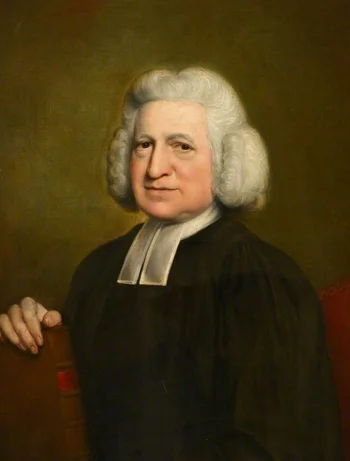
Credit: User Magnus Manske on en.wikipedia / Public domain