John Jacob Astor
July 17, 1763 — March 29, 1848 · Walldorf, Germany
John Jacob Astor was a German-born American businessman and fur trader who became the first multimillionaire in United States history. He arrived in New York penniless, entered the fur trade with relentless ambition, and eventually extended his empire to include the China trade and Manhattan real estate. At his death he was worth an estimated $20 million — equivalent to roughly $700 million or more today — making him easily the wealthiest person in America.
From Walldorf to New York
Born on July 17, 1763 in the small German town of Walldorf (near Heidelberg), Astor was the fourth son of a butcher. He left home at 17 to work in his brother's musical instrument shop in London, learning English and business fundamentals. Two years later, he sailed for America — arriving in Baltimore in 1784 with little money but a collection of flutes to sell and letters of introduction to German merchants in New York.
He settled in New York City and began buying and selling furs, quickly learning that the highest profits came from trading directly with Native American trappers in the interior and exporting the pelts to Europe. By 1800, Astor was already one of the most successful fur merchants in the country, with trade routes extending into the Great Lakes region and Canada.
American Fur Company and Pacific Ambitions
In 1808, Astor founded the American Fur Company, which grew into a near-monopoly on the American fur trade. He established trading posts across the interior, including Fort Astoria at the mouth of the Columbia River in present-day Oregon — America's first permanent settlement on the Pacific Coast. His vision included a commercial empire spanning the continent that would compete directly with British and Russian interests in the Pacific Northwest.
Simultaneously, Astor developed lucrative trade routes to China, shipping furs from the Pacific Northwest to Canton and returning with tea, silk, and porcelain. The China trade made several fortunes independently; combined with the fur business, it made Astor extraordinary wealth. He was one of the first Americans to operate a genuinely global commercial enterprise.
Did You Know?
John Jacob Astor was a passenger booked on an early voyage of the HMS Leopard but missed the ship due to business delays. He also survived multiple sea crossings that killed others around him. His great-great-grandson John Jacob Astor IV was not so fortunate — he died aboard the RMS Titanic in 1912, the wealthiest passenger on board.
Manhattan Real Estate and Lasting Legacy
As the fur trade declined in the 1830s, Astor shifted his focus to Manhattan real estate, buying land on the northern fringes of the city well before development reached it. His timing was perfect: New York's population exploded through the 1830s and 1840s, and the farms and lots he purchased for cents on the dollar became the most valuable urban real estate in the country. He stopped selling land and only leased it, creating an annuity of rentals that compounded with every decade. At his death on March 29, 1848, he left $400,000 to establish the Astor Library in New York City, which later became part of the New York Public Library. The Astor name endures in New York's Waldorf-Astoria Hotel, the neighborhood of Astoria in Queens, and the Oregon city of Astoria — named for the trading post that marked his westernmost ambition.
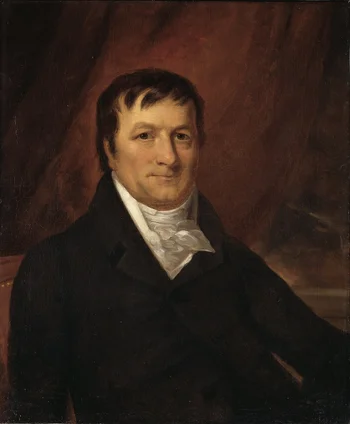
Credit: John Wesley Jarvis / Public domain