John Tyler
March 29, 1790 — January 18, 1862 · Charles City County, Virginia
John Tyler was the 10th President of the United States, serving from 1841 to 1845. He rose to office under extraordinary circumstances — when President William Henry Harrison died just 31 days into his term, Tyler became the first vice president to assume the presidency through succession, setting a constitutional precedent that shaped American government for generations.
Virginia Roots and Political Rise
Born on March 29, 1790 into a prominent planter family in Charles City County, Virginia, Tyler was immersed in politics from childhood. His father, John Tyler Sr., served as governor of Virginia. The younger Tyler graduated from the College of William & Mary at age 17, studied law, and was admitted to the bar at 19. His political career advanced rapidly — state legislator, U.S. congressman, governor of Virginia, and U.S. senator — making him one of the most credentialed men ever to assume the presidency.
A states' rights Democrat by conviction, Tyler had joined the Whig Party largely out of opposition to Andrew Jackson's style of executive power. The Whigs selected him as William Henry Harrison's running mate on the "Tippecanoe and Tyler Too" ticket of 1840, expecting him to attract Southern votes. Few imagined he would ever actually govern.
His Accidency: A Presidency Without a Party
When Harrison died on April 4, 1841, Tyler wasted no time asserting that he was president in full — not merely an "acting president" as some Whig leaders preferred. This determination set the precedent for all future vice-presidential successions, codified formally in the 25th Amendment in 1967. Tyler then proceeded to veto nearly every major piece of Whig legislation, including bills to re-establish a national bank. In retaliation, the Whig Party expelled him — making Tyler a president with no party, referred to derisively as "His Accidency."
Almost his entire cabinet resigned in protest. Tyler was the first president to face an impeachment resolution, though it failed in the House. He navigated the remainder of his term largely alone, relying on a small circle of loyal advisors from his Democratic past.
Did You Know?
John Tyler fathered 15 children — more than any other U.S. president. Two of his grandsons were still alive as recently as 2020, an astonishing span made possible because Tyler fathered children late in life, as did his son Lyon.
Annexation of Texas and Late Achievements
Despite his political isolation, Tyler notched a significant legacy achievement: the annexation of Texas. After the Senate twice rejected his treaty, Tyler maneuvered a joint resolution through Congress just days before he left office in March 1845, adding the Lone Star Republic as the 28th state. He also concluded a trade treaty with China and settled a boundary dispute with Britain over the Maine-Canada border through the Webster-Ashburton Treaty of 1842.
Confederate Turn and Final Years
Tyler's later years are marked by controversy. As the Civil War loomed, he chaired a peace convention in Washington in 1861 attempting to avert conflict, but when it failed, he sided with Virginia's secession. He was elected to the Confederate House of Representatives but died on January 18, 1862, before taking his seat — making him the only U.S. president whose death was never officially mourned by the federal government. His Virginia estate, Sherwood Forest, is still owned and maintained by his descendants.
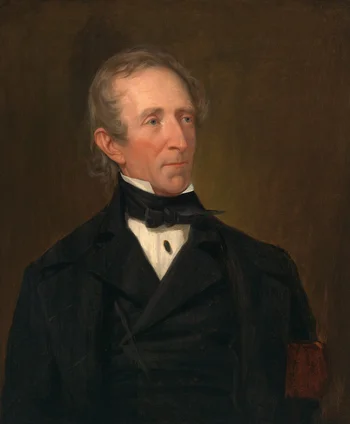
Credit: George Peter Alexander Healy / Public domain