Sam Walton
March 29, 1918 — April 5, 1992 · Kingfisher, Oklahoma
Sam Walton was an American retail entrepreneur who founded Walmart and Sam's Club, building the largest retail empire in history from a single variety store in Rogers, Arkansas. His philosophy of relentless frugality, supplier pressure, and geographic patience rewrote the rules of American commerce and made him, at the time of his death, the wealthiest man in the United States.
From Oklahoma to the Ben Franklin Franchise
Born on March 29, 1918 in Kingfisher, Oklahoma, during the hardship of the post-WWI farming economy, Walton learned frugality early. He worked his way through the University of Missouri, graduating in 1940 with a degree in economics, and briefly considered law school. Instead, he joined a J.C. Penney management training program, then served in the Army during World War II overseeing security at aircraft plants.
After the war, Walton borrowed money from his father-in-law and bought a Ben Franklin franchise store in Newport, Arkansas. His approach from the start was unconventional — he would drive to suppliers himself, negotiate hard, and pass every cent of savings to the customer. When his landlord refused to renew his lease (and took the store for himself), Walton simply started over in Bentonville, Arkansas, with a new store he called Walton's Five and Dime.
The First Walmart and the Small-Town Strategy
In 1962 — the same year Kmart and Target opened their first stores — Walton opened the first Walmart in Rogers, Arkansas. His target market was overlooked: small towns with populations between 5,000 and 25,000, too small to attract major chains but large enough to support a discount store. He believed these communities were underserved and that residents were tired of driving to cities for basic goods.
The strategy was patient and methodical. Walton would open stores in a ring around a distribution center, then fill in the middle once the logistics infrastructure was built. By the time competitors noticed, Walmart had saturated rural America with stores they couldn't profitably match.
Did You Know?
Sam Walton drove a beat-up 1979 Ford F-150 pickup truck until the end of his life and flew himself in a small prop plane to visit stores. Despite being the richest man in America, he got his hair cut at the local barbershop in Bentonville and ate at the coffee shop on the town square.
Technology, Supply Chain, and Scale
Walton invested aggressively in information technology long before it was fashionable in retail. In the 1980s, Walmart built its own satellite communications network to link all stores to headquarters in real time — at the time one of the largest private satellite systems in the world. This gave Walmart extraordinary inventory precision and allowed suppliers to see their own sales data, creating the tightly integrated supply chain that became Walmart's most durable competitive advantage.
By 1990, Walmart had surpassed Sears to become the largest retailer in the United States. Walton's memoir, Sam Walton: Made in America , published just weeks before his death, remains a widely read account of entrepreneurial persistence and unconventional thinking.
Legacy
Sam Walton died on April 5, 1992, from a bone cancer called multiple myeloma. He had been awarded the Presidential Medal of Freedom by George H.W. Bush just days before his death. Today, Walmart employs more than 2.3 million associates globally and remains the world's largest company by revenue. The Walton family, heirs to his fortune, are collectively among the wealthiest families on earth, though Sam Walton himself lived modestly until the end.
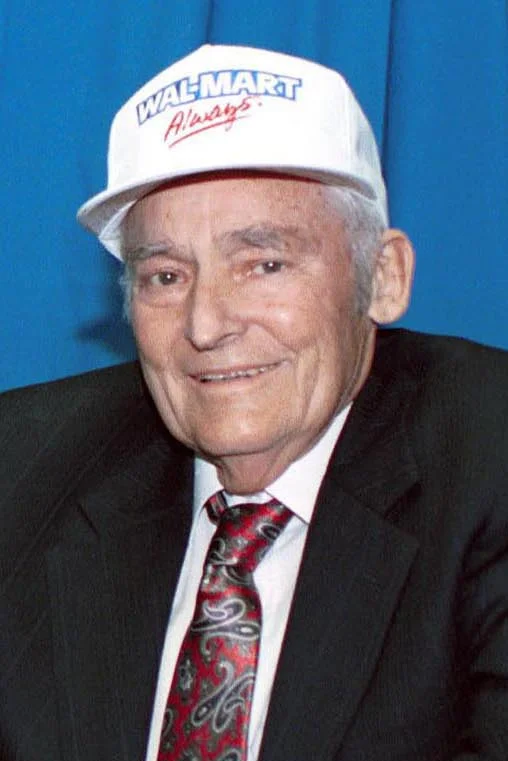
Credit: Photo credit: George Bush Presidential Library and Museum / Public domain