Vangelis
March 29, 1943 — May 17, 2022 · Agria, Greece
Evangelos Odysseas Papathanassiou — known universally as Vangelis — was a Greek composer and musician who pioneered the use of synthesizers in film and television scoring. His music for Chariots of Fire won the Academy Award for Best Original Score in 1982, and his haunting electronic soundtrack for Blade Runner became one of the most influential scores in science fiction cinema. Over five decades, he created a body of work spanning orchestral epics, ambient atmospheres, and music that reached millions of people who might not otherwise have sought out electronic composition.
Early Life and the Road to Synthesis
Born on March 29, 1943 in Agria, a coastal village in the Thessaly region of Greece, Papathanassiou taught himself to play piano by ear as a child, having never learned to read music — a fact that distinguished him from most of his contemporaries throughout his career. He was a prodigy who composed and performed purely by instinct.
In the 1960s he became a founding member of the Greek prog-rock group Aphrodite's Child, which achieved considerable success across Europe with hits including "Rain and Tears." The band's 1972 double album 666, a musical interpretation of the Book of Revelation, is now regarded as a cult classic of progressive rock. After the group dissolved, Vangelis relocated to London and later Paris, where he began the transition from rock to the synthesizer-based orchestral work that would define the rest of his career.
Chariots of Fire and the Oscar
Director Hugh Hudson approached Vangelis to score Chariots of Fire (1981), a British drama about two runners competing in the 1924 Olympics. The resulting score was unlike anything in mainstream film at the time — synthesizer washes and a deceptively simple main theme that felt both ancient and futuristic. The film won the Academy Award for Best Picture, and Vangelis won for Best Original Score. The main theme became one of the most recognized pieces of music on earth, used for decades in sports broadcasts, commercials, and parodies worldwide.
The same year, director Ridley Scott cast him to score Blade Runner, a dystopian science fiction film that performed modestly at the box office but became one of the most analyzed films in cinema history. Vangelis's score — dark, humid, hovering somewhere between jazz and ambient electronica — is inseparable from the film's identity and has influenced virtually every science fiction soundtrack that followed.
Did You Know?
Vangelis never learned to read or write music notation. He composed entirely by feel, recording directly at his synthesizer setup — a massive, custom-built rig he called "the Nemo Studio" — and relied on his extraordinary ear to build complex arrangements in real time without written scores.
Cosmos, Epic Collaborations, and Later Work
Vangelis's music reached its widest audience through Carl Sagan's 1980 television series Cosmos: A Personal Voyage, which used several of his pieces alongside new recordings. The series reached an estimated 500 million viewers in 60 countries, embedding his sound in the public imagination as the music of science and wonder. He collaborated extensively with Jon Anderson of Yes, releasing a series of albums under the name Jon & Vangelis that blended Anderson's ethereal vocals with Vangelis's synthesizer work. Later in his career he wrote music for the 2000 Sydney Olympics and the 2004 Athens Olympics — a fitting homecoming for a composer whose work always carried something of the ancient Greek landscape within it. Vangelis died on May 17, 2022, in Paris, at age 79.
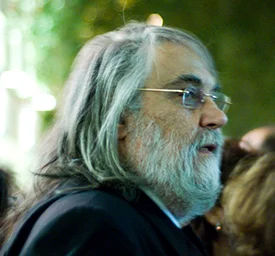
Credit: NikolasforWiki / CC BY-SA 3.0