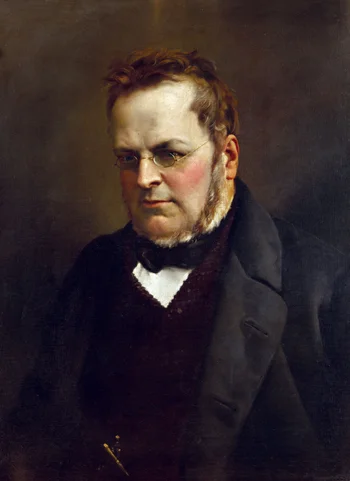
Alfred Döblin
August 10, 1878 — June 26, 1957
Alfred Döblin was a German novelist, physician, and essayist who wrote what is widely regarded as the greatest German novel of the twentieth century — Berlin Alexanderplatz (1929) — a modernist masterpiece of stream-of-consciousness narration, urban collage, and psychological depth that stands alongside Joyce's Ulysses and Dos Passos's Manhattan Transfer as one of the defining works of literary modernism.
Doctor and Writer
Born on August 10, 1878 in Stettin (now Szczecin, Poland) into a Jewish family, Döblin grew up in poverty in Berlin after his father abandoned the family. He studied medicine and became a practising psychiatrist, a career he maintained in parallel with his literary work throughout his life. He was a prolific writer from early in his career — his debut novel The Three Leaps of Wang Lun appeared in 1915 and was acclaimed by contemporaries including Bertolt Brecht — and he was deeply engaged with the expressionist and futurist literary movements of pre-war Germany. He was a friend of Herwarth Walden and contributed to the influential expressionist journal Der Sturm. His commitment to working in both medicine and literature was not compartmentalised; his psychiatric practice informed his fictional explorations of mental states, and his writing provided an outlet for observations his medical work generated.
Berlin Alexanderplatz
Published in 1929, Berlin Alexanderplatz: The Story of Franz Biberkopf follows a working-class man released from prison who attempts to go straight in the teeming urban world of Weimar-era Berlin and is progressively defeated by circumstances, by other people, and by his own weaknesses. What makes the novel revolutionary is its technique: Döblin employs interior monologue, newspaper headlines, advertising slogans, weather reports, street signs, biblical passages, and popular song lyrics alongside the narrative, creating a dense mosaic of urban life that attempts to capture the chaotic simultaneity of modern experience. The novel was immediately recognised as a major work and was adapted for both film and theatre. Rainer Werner Fassbinder's 1980 television adaptation, 15 episodes long, is itself considered one of the masterpieces of German cinema.
Did You Know?
When Döblin fled Germany in 1933 after the Nazi seizure of power, he crossed into France carrying almost nothing. He eventually reached the United States, where he worked for a period at MGM in Hollywood — a displacement that seemed absurd given his literary stature. He converted to Catholicism in 1941 and wrote a multi-volume novel about the Amazon, a river he had never seen. He returned to Germany after the war but found the country unrecognisable and spiritually destroyed; he left again in 1953 and died in Emmendingen, Germany in 1957, largely forgotten in his homeland.
Exile and Later Work
After the Nazis came to power in 1933, Döblin's books were among those burned in the public book burnings of May 1933. He fled to Paris, then to Hollywood, working briefly as a screenwriter, then to New York. His work during the exile years included a massive tetralogy, November 1918, about the German revolution at the end of World War I. He returned to West Germany after the war and worked in cultural reconstruction, but his later years were marked by illness, depression, and the sense that his literary reputation had not survived his absence. He died on June 26, 1957 in Emmendingen. His rehabilitation began after his death: Berlin Alexanderplatz was reissued, translated, and rediscovered by successive generations, and Döblin is now firmly established in the canon of twentieth-century world literature.