Eric Williams
September 25, 1911 — March 29, 1981 · Port of Spain, Trinidad
Eric Eustace Williams was a Trinidad-born historian, politician, and statesman who led his country from British colonial rule to independence and served as Trinidad and Tobago's first and only Prime Minister for 25 years until his death. Known as the "Father of the Nation," he was equally distinguished as an academic — his 1944 doctoral thesis, Capitalism and Slavery, is one of the most consequential works of Caribbean historical scholarship ever written and permanently changed how slavery and economic development are understood.
Scholar and Anti-Colonial Thinker
Born on September 25, 1911 in Port of Spain, Trinidad, Williams showed exceptional academic ability from childhood and won an Island Scholarship that took him to Queen's Royal College and then to Oxford University in 1932. He earned a first-class degree and a doctorate at Oxford, where his dissertation argued — controversially at the time — that the British abolition of the slave trade was driven more by economic self-interest than moral progress. The argument that capitalism created and then discarded the slave trade when it became unprofitable challenged the prevailing "moral triumph" narrative of British abolitionism.
His revised dissertation was published as Capitalism and Slavery in 1944, though it received little attention in Britain at the time. Over subsequent decades it became foundational to Caribbean studies and the broader fields of Atlantic history and postcolonial theory. Williams taught at Howard University in Washington, D.C. for several years before returning to Trinidad to enter politics.
University of Woodford Square and the Road to Independence
Williams founded the People's National Movement (PNM) in 1956 and transformed the public square in front of Port of Spain's Red House into what he called the "University of Woodford Square" — delivering marathon political lectures to thousands of citizens, educating them on colonial history, economics, and their own rights. The approach was without precedent: a doctoral historian campaigning for office by teaching.
The PNM swept the 1956 elections, making Williams Chief Minister of the colonial government. On August 31, 1962, Trinidad and Tobago achieved independence, with Williams as its first Prime Minister. He navigated the country through the oil boom of the 1970s, which briefly made Trinidad and Tobago one of the wealthiest countries in the Caribbean, and led the push for Caribbean integration through CARICOM.
Did You Know?
Eric Williams was profoundly deaf from an early age and wore a hearing aid throughout his adult life — a disability he refused to let define or limit him. He routinely removed the aid during political speeches to block out hecklers, meaning he literally could not hear the hostile parts of his own crowds.
Legacy
Williams led Trinidad and Tobago without interruption from 1956 until his sudden death on March 29, 1981 at age 69, found alone at his official residence in Valsayn. The cause of death was reported as complications from diabetes. His 25-year tenure remains the longest of any Prime Minister in the country's history. He left behind a nation shaped by his priorities — heavy investment in education, pride in Caribbean identity, and a determination that political independence be matched by economic self-determination. The Port of Spain International Airport is named the Piarco International Airport, but Williams's true monument is the independent nation he created and the historical arguments that changed how the world sees Atlantic slavery.
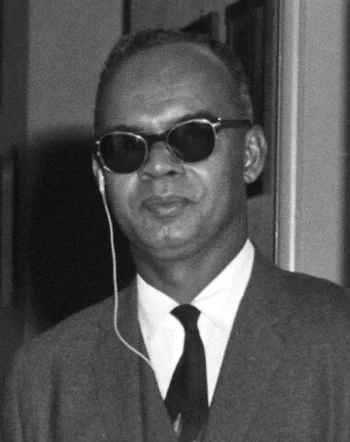
Credit: Joop van Bilsen for Anefo / CC0