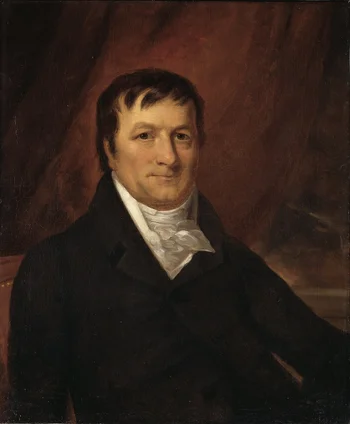
Paul Delaroche
July 17, 1797 — Paris, France
Paul Delaroche was a French painter whose meticulously detailed, emotionally intense historical scenes made him one of the most famous artists in Europe during the 1830s and 1840s, most celebrated for The Execution of Lady Jane Grey (1833), a painting whose blend of pathos, historical drama, and visual clarity captured the Victorian imagination and has never lost its hold on the popular eye.
Training and Early Career
Born on July 17, 1797 in Paris, Hippolyte-Paul Delaroche trained under Antoine-Jean Gros, the leading painter of Napoleonic subjects in France, and at the École des Beaux-Arts. He made his Salon debut in 1822 and almost immediately attracted attention with paintings that combined the precision and finish of Neoclassicism with the emotional charge and narrative interest of Romanticism. He was not simply a Romanticist: his work was distinguished from painters like Delacroix by its quieter, more composed emotional register and its insistence on archaeological accuracy — he researched the historical details of his subjects with a thoroughness that his contemporaries admired. His subjects were drawn primarily from English and French history: royal executions, deathbed scenes, moments of political and personal catastrophe frozen at their point of maximum dramatic intensity.
The Execution of Lady Jane Grey
Exhibited at the Paris Salon in 1834, The Execution of Lady Jane Grey (1833) depicts the 16-year-old queen of England — queen for nine days before being deposed and imprisoned in the Tower of London — kneeling blindfold at the chopping block, guided to it by the Lieutenant of the Tower while her ladies-in-waiting collapse in the background. The painting is an exercise in controlled grief: every figure, every gesture, every detail of period dress and architecture was researched and rendered with extreme care. It was an immediate sensation and is still considered Delaroche's masterpiece. After its disappearance for many decades (it had been sold to a Russian collector), it was rediscovered in the basement of the National Gallery in London in 1973 and now hangs in the gallery's permanent collection, where it consistently draws large crowds.
Did You Know?
When the French artist and critic Théophile Thoré-Bürger saw Delaroche's 1834 Salon entry, he is said to have exclaimed that "from this day, history painting is dead" — meaning that the extreme vividness of Delaroche's historical reconstructions, combining history with theatre, had made conventional classical history painting obsolete. Whether or not the quote is accurate, it captures the reaction of many contemporaries: Delaroche had found a new register for depicting the past, more emotionally accessible than academic classicism and more controlled than Romantic excess.
Later Career and Legacy
Delaroche received major official commissions throughout the 1830s and 1840s, including a large hemicycle fresco for the École des Beaux-Arts in Paris depicting great artists of all ages. He taught extensively and his studio produced several students who became significant painters. His wife, the daughter of the landscape painter Horace Vernet, died young, and he never fully recovered from the loss. He painted the series Napoleon at Fontainebleau (1840), depicting Napoleon signing his abdication with an expression of exhausted resignation, which became one of the most reproduced images of Napoleon in the nineteenth century. He died on November 4, 1856 in Paris. His reputation fluctuated: dismissed by modernists for what they saw as theatrical sentimentality, he has been substantially rehabilitated by art historians who recognise his technical mastery and his role in shaping the popular visual imagination of the nineteenth century.