On This Day — 9 February
2000s

2025
The Baltic states synchronize their electric power transmission infrastructure with the Continental Europe Synchronous Area (CESA), in objective to disconnect from the Russo-Belarussian agreement to use the IPS/UPS system.
Baltic states

2021
Second impeachment trial of Donald Trump begins.
Second impeachment trial of Donald Trump

2020
Salvadoran President Nayib Bukele has the army soldiers enter the Legislative Assembly to assist in pushing for the approval for a better government security plan, causing a brief political crisis.
Nayib Bukele

2018
Winter Olympics: Opening ceremony is performed in Pyeongchang County in South Korea.
2018 Winter Olympics

2016
Two passenger trains collide in the German town of Bad Aibling in the state of Bavaria. Twelve people die and 85 others are injured.
Bad Aibling rail accident

2001
The Ehime Maru and USS Greeneville collision takes place, killing nine of the thirty-five people on board the Japanese fishery high-school training ship Ehime Maru, leaving the USS Greeneville (SSN-772) with US $2 million in repairs, at Pearl Harbor.
Ehime Maru and USS Greeneville collision
1900s

1996
The Provisional Irish Republican Army declares the end to its 18-month ceasefire and explodes a large bomb in London's Canary Wharf, killing two people.
Provisional Irish Republican Army
1996
Copernicium is discovered by Sigurd Hofmann, Victor Ninov et al.
Copernicium

1991
Dissolution of the Soviet Union: Voters in Lithuania vote for independence from the Soviet Union.
Dissolution of the Soviet Union

1987
Civil unrest broke out across Palestine.
February 1987 Palestinian unrest

1986
Halley's Comet last appeared in the inner Solar System.
Halley's Comet

1982
Japan Air Lines Flight 350 crashes near Haneda Airport in an attempted pilot mass murder-suicide, killing 24 of the 174 people on board.
Japan Air Lines Flight 350

1978
The Budd Company unveils its first SPV-2000 self-propelled railcar in Philadelphia, Pennsylvania.
Budd Company

1976
Aeroflot Flight 3739, a Tupolev Tu-104, crashes during takeoff from Irkutsk Airport, killing 24.
Aeroflot Flight 3739 (1976)

1975
The Soyuz 17 Soviet spacecraft returns to Earth.
Soyuz 17

1971
The 6.5–6.7 Mw Sylmar earthquake hits the Greater Los Angeles Area with a maximum Mercalli intensity of XI (Extreme), killing 64 and injuring 2,000.
1971 San Fernando earthquake

1971
Satchel Paige becomes the first Negro league player to be voted into the USA's Baseball Hall of Fame.
Satchel Paige

1971
Apollo program: Apollo 14 returns to Earth after the third human Moon landing.
Apollo program

1965
Vietnam War: The United States Marine Corps sends a MIM-23 Hawk missile battalion to South Vietnam, the first American troops in-country without an official advisory or training mission.
Vietnam War

1964
The Beatles make their first appearance on The Ed Sullivan Show, performing before a record-setting audience of 73 million viewers across the United States.
The Beatles

1961
The Beatles at the Cavern Club: Lunchtime – The Beatles perform under this name at The Cavern Club for the first time following their return to Liverpool from Hamburg.
The Beatles at the Cavern Club

1959
The R-7 Semyorka, the first intercontinental ballistic missile, becomes operational at Plesetsk, USSR.
R-7 Semyorka

1951
Korean War: The two-day Geochang massacre begins as a battalion of the 11th Division of the South Korean Army kills 719 unarmed citizens in Geochang, in the South Gyeongsang district of South Korea.
Korean War

1950
Second Red Scare: US Senator Joseph McCarthy accuses the United States Department of State of being filled with Communists.
McCarthyism

1945
World War II: Battle of the Atlantic: HMS Venturer sinks U-864 off the coast of Fedje, Norway, in a rare instance of submarine-to-submarine combat.
Battle of the Atlantic

1945
World War II: A force of Allied aircraft unsuccessfully attack a German destroyer in Førdefjorden, Norway.
Allies of World War II

1943
World War II: Pacific War: Allied authorities declare Guadalcanal secure after Imperial Japan evacuates its remaining forces from the island, ending the Battle of Guadalcanal.
Pacific War
1942
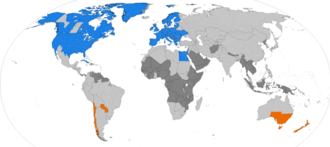
Year-round Daylight saving time (aka War Time) is reinstated in the United States as a wartime measure to help conserve energy resources.
Daylight saving time

1941
World War II: Bombing of Genoa: The Cathedral of San Lorenzo in Genoa, Italy, is struck by a bomb which fails to detonate.
World War II

1934
The Balkan Entente is formed between Greece, Romania, Yugoslavia, and Turkey.
Balkan Pact

1932
Prohibition law is abolished in Finland after a national referendum, where 70% voted for a repeal of the law.
Prohibition

1929
Members of the Việt Nam Quốc Dân Đảng assassinate the labor recruiter Bazin, prompting a crackdown by French colonial authorities.
Việt Nam Quốc Dân Đảng

1922
Brazil becomes a member of the Berne Convention copyright treaty.
Brazil

1920
Under the terms of the Svalbard Treaty, international diplomacy recognizes Norwegian sovereignty over Arctic archipelago Svalbard, and designates it as demilitarized.
Svalbard Treaty

1913
A group of meteors is visible across much of the eastern seaboard of the Americas, leading astronomers to conclude the source had been a small, short-lived natural satellite of the Earth.
Meteor

1907
The Mud March is the first large procession organised by the National Union of Women's Suffrage Societies (NUWSS).
Mud March (suffragists)

1904
Russo-Japanese War: Battle of Port Arthur concludes.
Russo-Japanese War

1900
The Davis Cup competition is established.
Davis Cup
1800s

1895
William G. Morgan creates a game called Mintonette, which soon comes to be referred to as volleyball.
William G. Morgan

1893
Verdi's last opera, Falstaff, premieres at La Scala, Milan.
Giuseppe Verdi

1889
US president Grover Cleveland signs a bill elevating the United States Department of Agriculture to a Cabinet-level agency.
Grover Cleveland

1870
US president Ulysses S. Grant signs a joint resolution of Congress establishing the U.S. Weather Bureau.
Ulysses S. Grant

1861
American Civil War: Jefferson Davis is elected the Provisional President of the Confederate States of America by the Provisional Confederate Congress at Montgomery, Alabama.
American Civil War

1849
The new Roman Republic is declared.
Roman Republic (1849–1850)

1825
After no candidate receives a majority of electoral votes in the US presidential election of 1824, the United States House of Representatives elects John Quincy Adams as sixth President of the United States in a contingent election.
United States Electoral College

1822
Haiti attacks the newly established Dominican Republic on the other side of the island of Hispaniola.
Haiti
Before 1800

1778
Rhode Island becomes the fourth US state to ratify the Articles of Confederation.
Rhode Island

1775
American Revolutionary War: The British Parliament declares Massachusetts in rebellion.
American Revolutionary War

1654
The Capture of Fort Rocher takes place during the Anglo-Spanish War.
Capture of Fort Rocher

1621
Gregory XV becomes Pope, the last Pope elected by acclamation.
Pope Gregory XV

1555
Bishop of Gloucester John Hooper is burned at the stake.
Bishop of Gloucester

1539
The first recorded race is held on Chester Racecourse, known as the Roodee.
Chester Racecourse

1098
A First Crusade army led by Bohemond of Taranto wins a major battle against the Seljuq emir Ridwan of Aleppo during the siege of Antioch.
First Crusade

1003
Boleslaus III is restored to authority with armed support from Bolesław I the Brave of Poland.
Boleslaus III, Duke of Bohemia

474
Zeno is crowned as co-emperor of the Eastern Roman Empire.
Zeno (emperor)