On This Day — 23 August
2000s

2023
Chandrayaan-3 mission initiated first Moon landing in Indian history.
Chandrayaan-3

2023
A business jet carrying key leadership members of the Russian private military company Wagner Group crashes, killing all ten people on board.
Wagner Group
2013
A riot at the Palmasola prison complex in Santa Cruz, Bolivia kills 31 people.
2013 Palmasola prison riot
2012
A hot-air balloon crashes near the Slovenian capital of Ljubljana, killing six people and injuring 28 others.
2012 Ljubljana Marshes hot air balloon crash

2011
A magnitude 5.8 (class: moderate) earthquake occurs in Virginia. Damage occurs to monuments and structures in Washington, D.C. and the resulted damage is estimated at 200 million–300 million USD.
2011 Virginia earthquake

2011
Libyan leader Muammar Gaddafi is overthrown after the National Transitional Council forces take control of Bab al-Azizia compound during the Libyan Civil War.
Muammar Gaddafi
2010
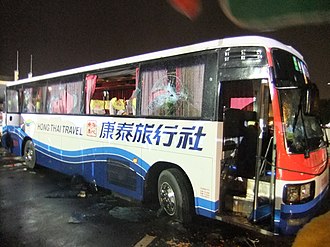
The Manila hostage crisis occurred near the Quirino Grandstand in Manila, Philippines killing 9 people including the perpetrator while injuring 9 others.
Manila hostage crisis

2007
The skeletal remains of Russia's last royal family members Alexei Nikolaevich, Tsarevich of Russia, and his sister Grand Duchess Anastasia are discovered near Yekaterinburg, Russia.
Alexei Nikolaevich, Tsarevich of Russia

2006
Natascha Kampusch, who had been abducted at the age of ten, escapes from her captor Wolfgang Přiklopil, after eight years of captivity.
Natascha Kampusch

2000
Gulf Air Flight 072 crashes into the Persian Gulf near Manama, Bahrain, killing 143.
Gulf Air Flight 072
1900s
1994
Eugene Bullard, the only African American pilot in World War I, is posthumously commissioned as Second Lieutenant in the United States Air Force.
Eugene Bullard

1991
The World Wide Web is opened to the public.
World Wide Web
1990
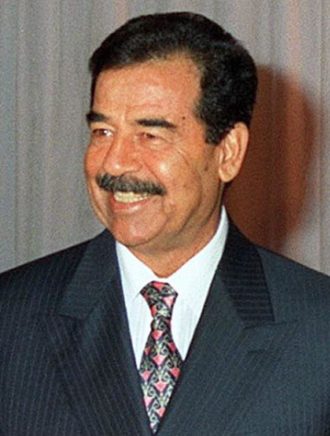
Saddam Hussein appears on Iraqi state television with a number of Western "guests" (actually hostages) to try to prevent the Gulf War.
Saddam Hussein

1990
Armenia declares its independence from the Soviet Union.
Armenia

1990
West and East Germany announce that they will reunite on October 3.
German reunification

1989
Singing Revolution: Two million people from Estonia, Latvia and Lithuania stand on the Vilnius–Tallinn road, holding hands.
Singing Revolution
1985
Hans Tiedge, top counter-spy of West Germany, defects to East Germany.
Hans Tiedge

1975
The start of the Wave Hill walk-off by Gurindji people in Australia, lasting eight years, a landmark event in the history of Indigenous land rights in Australia, commemorated in a 1991 Paul Kelly song and an annual celebration.
Wave Hill walk-off

1975
The Pontiac Silverdome opens in Pontiac, Michigan, 30 miles (48 km) northwest of Detroit, Michigan
Pontiac Silverdome

1973
A bank robbery gone wrong in Stockholm, Sweden, turns into a hostage crisis; over the next five days the hostages begin to sympathise with their captors, leading to the term "Stockholm syndrome".
Norrmalmstorg robbery

1970
Organized by Mexican American labor union leader César Chávez, the Salad Bowl strike, the largest farm worker strike in U.S. history, begins.
Mexican Americans

1966
Lunar Orbiter 1 takes the first photograph of Earth from orbit around the Moon.
Lunar Orbiter 1

1958
Chinese Civil War: The Second Taiwan Strait Crisis begins with the People's Liberation Army's bombardment of Quemoy.
Chinese Civil War

1954
The first flight of the Lockheed C-130 multi-role aircraft takes place.
Lockheed C-130 Hercules

1954
The Cruise of the Kings, a royal cruise organised by the Queen Consort of Greece, Frederica of Hanover, departs from Marseille, France.
Cruise of the Kings

1948
The World Council of Churches is formed by 147 churches from 44 countries.
World Council of Churches
1946
Ordinance No. 46 of the British Military Government constitutes the German Länder (states) of Hanover and Schleswig-Holstein.
Ordinance No. 46

1945
World War II: Soviet–Japanese War: The USSR State Defense Committee issues Decree no. 9898cc "About Receiving, Accommodation, and Labor Utilization of the Japanese Army Prisoners of War".
Soviet–Japanese War

1944
World War II: Marseille is liberated by the Allied forces.
Marseille

1944
World War II: King Michael of Romania dismisses the pro-Nazi government of Marshal Antonescu, who is later arrested. Romania switches sides from the Axis to the Allies.
Michael I of Romania

1944
Freckleton air disaster: A United States Army Air Forces B-24 Liberator bomber crashes into a school in Freckleton, England, killing 61 people.
Freckleton Air Disaster

1943
World War II: Kharkiv is liberated by the Soviet Red Army for the second time after the Battle of Kursk.
Kharkiv

1942
World War II: Beginning of the Battle of Stalingrad.
Battle of Stalingrad

1939
World War II: Nazi Germany and the Soviet Union sign the Molotov–Ribbentrop Pact. In a secret protocol to the pact, Poland, Finland, Estonia, Latvia, Lithuania, and Romania are divided into German and Soviet "spheres of influence".
World War II

1929
Hebron Massacre during the 1929 Palestine riots: Arab attacks on the Jewish community in Hebron in the British Mandate of Palestine occur, continuing until the next day, resulting in the death of 65–68 Jews and the remaining Jews being forced to leave the city.
1929 Hebron massacre

1927
Italian anarchists Sacco and Vanzetti are executed after a lengthy, controversial trial.
Sacco and Vanzetti

1923
Captain Lowell Smith and Lieutenant John P. Richter perform the first mid-air refueling on De Havilland DH-4B, setting an endurance flight record of 37 hours.
Captain (United States O-3)

1921
British airship R-38 experiences structural failure over Hull in England and crashes in the Humber Estuary; of her 49 British and American training crew, only four survive.
R38-class airship

1914
World War I: The British Expeditionary Force and the French Fifth Army begin their Great Retreat before the German Army.
World War I
1914
World War I: Japan declares war on Germany.
Japan during World War I

1904
The automobile tire chain is patented.
Snow chains
1800s

1898
The Southern Cross Expedition, the first British venture of the Heroic Age of Antarctic Exploration, departs from London.
Southern Cross Expedition

1873
The Albert Bridge in Chelsea, London opens.
Albert Bridge, London

1866
The Austro-Prussian War ends with the Treaty of Prague.
Austro-Prussian War

1864
American Civil War: The Union Navy captures Fort Morgan, Alabama, thus breaking Confederate dominance of all ports on the Gulf of Mexico except Galveston, Texas.
American Civil War

1839
The United Kingdom captures Hong Kong as a base as it prepares for the First Opium War with Qing China.
First Opium War

1831
Nat Turner's rebellion of enslaved Virginians is suppressed.
Nat Turner's Rebellion

1813
At the Battle of Großbeeren, the Prussians under Von Bülow repulse the French army.
Battle of Großbeeren
Before 1800
1799
Napoleon Bonaparte leaves Egypt for France en route to seizing power.
Napoleon

1784
Western North Carolina (now eastern Tennessee) declares itself an independent state under the name of Franklin; it is not accepted into the United States, and only lasts for four years.
North Carolina

1782
British forces under Edward Despard complete the reconquest of the Black River settlements on the Mosquito Coast from the Spanish.
Edward Despard

1775
American Revolutionary War: King George III delivers his Proclamation of Rebellion to the Court of St James's stating that the American colonies have proceeded to a state of open and avowed rebellion.
American Revolutionary War
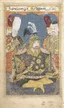
1703
Edirne event: Sultan Mustafa II of the Ottoman Empire is dethroned.
Edirne Incident
1655
Battle of Sobota: The Swedish Empire led by Charles X Gustav defeats the Polish–Lithuanian Commonwealth.
Battle of Sobota

1628
George Villiers, the first Duke of Buckingham, is assassinated by John Felton.
George Villiers, 1st Duke of Buckingham

1600
Battle of Gifu Castle: The eastern forces of Tokugawa Ieyasu defeat the western Japanese clans loyal to Toyotomi Hideyori, leading to the destruction of Gifu Castle and serving as a prelude to the Battle of Sekigahara.
Battle of Gifu Castle

1595
Long Turkish War: Wallachian prince Michael the Brave confronts the Ottoman army in the Battle of Călugăreni and achieves a tactical victory.
Long Turkish War

1572
French Wars of Religion: Mob violence against thousands of Huguenots in Paris results in the St. Bartholomew's Day massacre.
French Wars of Religion

1541
French explorer Jacques Cartier lands near Quebec City in his third voyage to Canada.
Jacques Cartier

1521
Christian II of Denmark is deposed as king of Sweden and Gustav Vasa is elected regent.
Christian II of Denmark

1514
The Battle of Chaldiran ends with a decisive victory for the Sultan Selim I, Ottoman Empire, over the Shah Ismail I, founder of the Safavid dynasty.
Battle of Chaldiran

1382
The Golden Horde, led by Khan Tokhtamysh, begins the Siege of Moscow, which ends four days later with the storming of the city and the death of Muscovite Prince Ostei.
Golden Horde

1328
Battle of Cassel: French troops stop an uprising of Flemish farmers.
Battle of Cassel (1328)
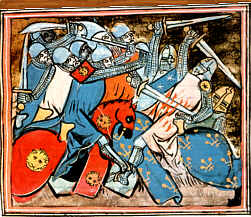
1268
The Battle of Tagliacozzo: The army of Prince Conradin is nearly destroyed by Charles of Anjou, ending Hohenstaufen control over the Kingdom of Sicily and leaving the Angevins in control.
Battle of Tagliacozzo

1244
Siege of Jerusalem: The city surrenders to the Khwarazmiyya, ending Christian control of the Jerusalem for the next 672 years.
Siege of Jerusalem (1244)

476
Odoacer, chieftain of the Germanic tribes (Herulic – Scirian foederati), is proclaimed rex Italiae ("King of Italy") by his troops.
Odoacer
79
Mount Vesuvius begins stirring, on the feast day of Vulcan, the Roman god of fire.
AD 79