On This Day — 15 February
2000s

2021
Sixty people drown and hundreds are missing after a boat sinks on the Congo River near the village of Longola Ekoti, Mai-Ndombe Province, Democratic Republic of the Congo.
2021 Congo River disaster

2013
A meteor explodes over Russia, injuring 1,500 people as a shock wave blows out windows and rocks buildings. This happens unexpectedly only hours before the expected closest ever approach of the larger and unrelated asteroid 2012 DA14.
Chelyabinsk meteor
2012
Three hundred and sixty people die in a fire at a Honduran prison in the city of Comayagua.
Comayagua prison fire
2010
Two trains collide in the Halle train collision in Halle, Belgium, killing 19 and injuring 171 people.
Halle train collision

2003
Protests against the Iraq war take place in over 600 cities worldwide. It is estimated that between eight million and 30 million people participate, making this the largest peace demonstration in history.
15 February 2003 Iraq War protests
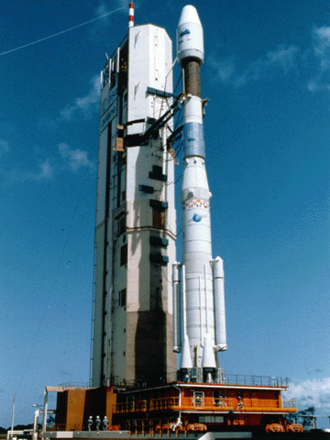
2003
The last Ariane 4 rocket is launched from the Guiana Space Centre, carrying Intelsat 907.
Ariane 4

2001
The first draft of the complete human genome is published in Nature.
Human genome
1900s

1996
At the Xichang Satellite Launch Center in China, a Long March 3B rocket carrying Intelsat 708 veers off course and crashes into a rural village after liftoff, killing somewhere between six and 100 people.
Xichang Satellite Launch Center

1996
Then-Prime Minister of Canada Jean Chrétien applies a chokehold to protester Bill Clennett, an incident later named the Shawinigan Handshake.
Prime Minister of Canada

1992
Serial killer Jeffrey Dahmer is sentenced in Milwaukee to 15 terms of life in prison.
Jeffrey Dahmer

1992
Air Transport International Flight 805 crashes in Swanton, Ohio, near Toledo Express Airport, killing all four people on board.
Air Transport International Flight 805

1991
The Visegrád Group, establishing cooperation to move toward free-market systems, is signed by the leaders of Czechoslovakia, Hungary and Poland.
Visegrád Group

1989
Soviet–Afghan War: The Soviet Union officially announces that all of its troops have left Afghanistan.
Soviet–Afghan War

1982
The drilling rig Ocean Ranger sinks during a storm off the coast of Newfoundland, killing 84 workers.
Drilling rig

1972
Sound recordings are granted U.S. federal copyright protection for the first time.
Sound recording and reproduction

1972
José María Velasco Ibarra, serving as President of Ecuador for the fifth time, is overthrown by the military for the fourth time.
José María Velasco Ibarra
1971
The decimalisation of the currencies of the United Kingdom and Ireland is completed on Decimal Day.
Decimalisation

1970
Dominicana de Aviación Flight 603 crashes into the Caribbean Sea after takeoff from Las Américas International Airport, killing 102, including members of the Puerto Rico women's national volleyball team and lightweight boxer Carlos Cruz.
Dominicana de Aviación Flight 603

1965
The maple leaf is adopted as the flag of Canada, replacing the Canadian Red Ensign flag.
Maple leaf

1961
Sabena Flight 548 crashes in Belgium, killing 73, including the entire United States figure skating team along with several of their coaches and family members.
Sabena Flight 548

1954
Canada and the United States agree to construct the Distant Early Warning Line, a system of radar stations in the far northern Arctic regions of Canada and Alaska.
Distant Early Warning Line

1952
King George VI of the United Kingdom is buried in St George's Chapel, Windsor Castle.
George VI

1949
Gerald Lankester Harding and Roland de Vaux begin excavations at Cave 1 of the Qumran Caves, where they will eventually discover the first seven Dead Sea Scrolls.
Gerald Lankester Harding

1946
ENIAC, the first electronic general-purpose computer, is formally dedicated at the University of Pennsylvania in Philadelphia.
ENIAC

1945
World War II: Third day of bombing in Dresden.
Bombing of Dresden

1944
World War II: The assault on Monte Cassino, Italy, begins.
Battle of Monte Cassino

1944
World War II: The Narva Offensive begins.
Narva offensive (15–28 February 1944)

1942
World War II: Fall of Singapore. Following an assault by Japanese forces, the British General Arthur Percival surrenders. About 80,000 Indian, United Kingdom and Australian soldiers become prisoners of war, the largest surrender of British-led military personnel in history.
World War II

1940
Paul Creston's Saxophone Sonata is officially premiered at the Carnegie Chamber Hall by saxophonist Cecil Leeson, who had commissioned it, and the composer.
Paul Creston

1933
In Miami, Giuseppe Zangara attempts to assassinate US President-elect Franklin D. Roosevelt, but instead shoots Chicago mayor Anton J. Cermak, who dies of his wounds on March 6.
Miami

1925
The 1925 serum run to Nome: The second delivery of serum arrives in Nome, Alaska.
1925 serum run to Nome

1923
Greece becomes the last European country to adopt the Gregorian calendar.
Greece

1909
The Flores Theater fire in Acapulco, Mexico, kills 250.
Acapulco
1800s

1899
Tsar Nicholas II of Russia issues a declaration known as the February Manifesto, which reduces the autonomy of the Grand Duchy of Finland, thus beginning the first period of oppression.
Nicholas II

1898
The battleship USS Maine explodes and sinks in Havana harbor in Cuba, killing about 274 of the ship's roughly 354 crew. The disaster pushes the United States to declare war on Spain.
USS Maine (1890)

1879
Women's rights: US President Rutherford B. Hayes signs a bill allowing female attorneys to argue cases before the Supreme Court of the United States.
Women's rights

1872
First issue of the Bulletin de la Fédération jurassienne, the first or one of the first anarchist newspapers.
Bulletin de la Fédération jurassienne

1870
Stevens Institute of Technology is founded in New Jersey, US, and offers the first Bachelor of Engineering degree in mechanical engineering.
Stevens Institute of Technology

1862
American Civil War: Confederates commanded by Brig. Gen. John B. Floyd attack General Ulysses S. Grant's Union forces besieging Fort Donelson in Tennessee. Unable to break the fort's encirclement, the Confederates surrender the following day.
American Civil War

1852
The Helsinki Cathedral (known as St. Nicholas' Church at time) is officially inaugurated in Helsinki, Finland.
Helsinki Cathedral

1835
Serbia's Sretenje Constitution briefly comes into effect.
1835 Constitution of Serbia
Before 1800

1798
The Roman Republic is proclaimed after Louis-Alexandre Berthier, a general of Napoleon, had invaded the city of Rome five days earlier.
Roman Republic (1798–1799)

1764
The city of St. Louis is established in Spanish Louisiana (now in Missouri, USA).
St. Louis

1690
Constantin Cantemir, Prince of Moldavia, and the Holy Roman Empire sign a secret treaty in Sibiu, stipulating that Moldavia would support the actions led by the House of Habsburg against the Ottoman Empire.
Constantin Cantemir

1637
Ferdinand III becomes Holy Roman Emperor.
Ferdinand III, Holy Roman Emperor

1493
While on board the Niña, Christopher Columbus writes an open letter (widely distributed upon his return to Portugal) describing his discoveries and the unexpected items he came across in the New World.
Niña (ship)
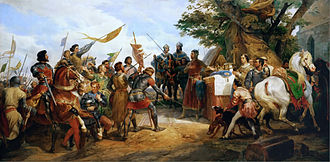
1214
During the Anglo-French War (1213–1214), an English invasion force led by John, King of England, lands at La Rochelle in France.
Anglo-French War (1213–1214)

1113
Pope Paschal II issues Pie Postulatio Voluntatis, recognizing the Order of Hospitallers.
Pope Paschal II

1002
At an assembly at Pavia of Lombard nobles, Arduin of Ivrea is restored to his domains and crowned King of Italy.
Pavia

706
Byzantine emperor Justinian II has his predecessors Leontios and Tiberios III publicly executed in the Hippodrome of Constantinople.
Byzantine Empire

590
Khosrau II is crowned king of Persia.
Khosrow II

438
Roman emperor Theodosius II publishes the law codex Codex Theodosianus.
Ancient Rome