On This Day — 20 May
2000s

2022
Russo-Ukrainian war: Russia claims full control of the Ukrainian city of Mariupol after a nearly three-month siege.
Russo-Ukrainian war

2019
The International System of Units (SI): The base units are redefined, making the international prototype of the kilogram obsolete.
International System of Units

2016
The government of Singapore authorised the controversial execution of convicted murderer Kho Jabing for the murder of a Chinese construction worker despite the international pleas for clemency, notably from Amnesty International and the United Nations.
Singapore
2013
An EF5 tornado strikes the Oklahoma City suburb of Moore, killing 24 people and injuring 377 others.
Enhanced Fujita scale

2012
At least 27 people are killed and 50 others injured when a 6.0-magnitude earthquake strikes northern Italy.
2012 Northern Italy earthquakes

2011
Mamata Banerjee is sworn in as the Chief Minister of West Bengal, the first woman to hold this post.
Mamata Banerjee

2009
An Indonesian Air Force Lockheed L-100 Hercules crashes in Magetan Regency, killing 99.
Indonesian Air Force

2002
The independence of East Timor is recognized by Portugal, formally ending 23 years of Indonesian rule and three years of provisional UN administration (Portugal itself is the former colonizer of East Timor until 1976).
Timor-Leste
1900s

1996
Civil rights: The Supreme Court of the United States rules in Romer v. Evans against a law that would have prevented any city, town or county in the state of Colorado from taking any legislative, executive, or judicial action to protect the rights of gays and lesbians.
LGBTQ rights in the United States
1990
The first post-Communist presidential and parliamentary elections are held in Romania.
Communism

1989
The Chinese authorities declare martial law in the face of pro-democracy demonstrations, setting the scene for the Tiananmen Square massacre.
Democracy

1985
Radio Martí, part of the Voice of America service, begins broadcasting to Cuba.
Radio y Televisión Martí

1983
First publications of the discovery of the HIV virus that causes AIDS in the journal Science by a team of French scientists including Françoise Barré-Sinoussi, Jean-Claude Chermann, and Luc Montagnier.
HIV
1983
Church Street bombing: A car bomb planted by UMkhonto we Sizwe explodes on Church Street in South Africa's capital, Pretoria, killing 19 people and injuring 217 others.
Church Street, Pretoria bombing
1980
In a referendum in Quebec, the population rejects, with 60% of the vote, a government proposal to move towards independence from Canada.
1980 Quebec referendum
1971
In the Chuknagar massacre, Pakistani forces massacre thousands, mostly Bengali Hindus.
Chuknagar massacre

1969
The Battle of Hamburger Hill in Vietnam ends.
Battle of Hamburger Hill

1967
The Popular Movement of the Revolution political party is established in the Democratic Republic of the Congo.
Popular Movement of the Revolution

1965
One hundred twenty-one people are killed when Pakistan International Airlines Flight 705 crashes at Cairo International Airport.
Pakistan International Airlines Flight 705

1964
Discovery of the cosmic microwave background radiation by Robert Woodrow Wilson and Arno Penzias.
Discovery of cosmic microwave background radiation

1958
Capital Airlines Flight 300 collides in mid-air with a United States Air Force Lockheed T-33 over Brunswick, Maryland, killing 12.
Capital Airlines Flight 300

1956
In Operation Redwing, the first United States airborne hydrogen bomb is dropped over Bikini Atoll in the Pacific Ocean.
Operation Redwing

1949
In the United States, the Armed Forces Security Agency, the predecessor to the National Security Agency, is established.
National Security Agency

1948
Generalissimo Chiang Kai-shek wins the 1948 Republic of China presidential election and is sworn in as the first President of the Republic of China at Nanjing.
Chiang Kai-shek

1943
The Luttra Woman, a bog body from the Early Neolithic period (radiocarbon-dated c. 3928–3651 BC), was discovered near Luttra, Sweden.
Luttra Woman

1941
World War II: Battle of Crete: German paratroops invade Crete.
Battle of Crete

1940
The Holocaust: The first prisoners arrive at a new concentration camp at Auschwitz.
The Holocaust

1932
Amelia Earhart takes off from Newfoundland to begin the world's first solo nonstop flight across the Atlantic Ocean by a female pilot, landing in Ireland the next day.
Amelia Earhart

1927
Treaty of Jeddah: The United Kingdom recognizes the sovereignty of King Ibn Saud in the Kingdoms of Hejaz and Nejd, which later merge to become the Kingdom of Saudi Arabia.
Treaty of Jeddah (1927)

1927
Charles Lindbergh takes off for Paris from Roosevelt Field in Long Island, N.Y., aboard the Spirit of St. Louis on the first nonstop solo flight across the Atlantic Ocean, landing 33+1⁄2 hours later.
Charles Lindbergh

1902
Cuba gains independence from the United States. Tomás Estrada Palma becomes the country's first President.
Cuba
1800s
1891
History of cinema: The first public display of Thomas Edison's prototype kinetoscope.
History of film

1883
Krakatoa begins to erupt; the volcano explodes three months later, killing more than 36,000 people.
Krakatoa

1882
The Triple Alliance between the German Empire, Austria-Hungary and the Kingdom of Italy is formed.
Triple Alliance (1882)

1875
Signing of the Metre Convention by 17 nations leading to the establishment of the International System of Units.
Metre Convention

1873
Levi Strauss and Jacob Davis receive a U.S. patent for blue jeans with copper rivets.
Levi Strauss
1864
American Civil War: Battle of Ware Bottom Church: In the Virginia Bermuda Hundred campaign, 10,000 troops fight in this Confederate victory.
Battle of Ware Bottom Church

1862
U.S. President Abraham Lincoln signs the Homestead Act into law, opening eighty-four million acres (340,000 km2) of public land to settlers.
Abraham Lincoln

1861
American Civil War: The state of Kentucky proclaims its neutrality, which will last until September 3 when Confederate forces enter the state.
American Civil War
1861
American Civil War: The State of North Carolina secedes from the Union.
American Civil War

1813
Napoleon Bonaparte leads his French troops into the Battle of Bautzen in Saxony, Germany, against the combined armies of Russia and Prussia. The battle ends the next day with a French victory.
Battle of Bautzen (1813)

1802
By the Law of 20 May 1802, Napoleon Bonaparte reinstates slavery in the French colonies, revoking its abolition in the French Revolution.
Law of 20 May 1802
Before 1800

1775
The Mecklenburg Declaration of Independence is allegedly signed in Charlotte, North Carolina.
Mecklenburg Declaration of Independence

1741
The Battle of Cartagena de Indias ends in a Spanish victory and the British begin withdrawal towards Jamaica with substantial losses.
Battle of Cartagena de Indias

1714
Johann Sebastian Bach leads the first performance of his cantata for Pentecost, Erschallet, ihr Lieder, BWV 172, at the chapel of Schloss Weimar.
Johann Sebastian Bach

1645
Yangzhou massacre: The ten day massacre of the residents of the city of Yangzhou, part of the Transition from Ming to Qing.
Yangzhou massacre

1631
The city of Magdeburg in Germany is seized by forces of the Holy Roman Empire and most of its inhabitants massacred, in one of the bloodiest incidents of the Thirty Years' War.
Magdeburg

1609
Shakespeare's sonnets are first published in London, perhaps illicitly, by the publisher Thomas Thorpe.
Shakespeare's sonnets

1570
Cartographer Abraham Ortelius issues Theatrum Orbis Terrarum, the first modern atlas.
Cartography

1521
Ignatius of Loyola is seriously wounded in the Battle of Pampeluna.
Ignatius of Loyola

1520
Hernan Cortés defeats Pánfilo de Narváez, sent by Spain to punish him for insubordination.
Hernán Cortés

1498
Portuguese explorer Vasco da Gama discovers the sea route to India when he arrives at Kozhikode (previously known as Calicut), India.
Vasco da Gama

1497
John Cabot sets sail from Bristol, England, on his ship Matthew looking for a route to the west (other documents give a May 2 date).
John Cabot

1449
The Battle of Alfarrobeira is fought, establishing the House of Braganza as a principal royal family of Portugal.
Battle of Alfarrobeira
1426
King Mohnyin Thado formally ascends to the throne of Ava.
Mohnyin Thado
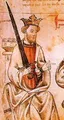
1293
King Sancho IV of Castile creates the Estudio de Escuelas de Generales in Alcalá de Henares.
Sancho IV of Castile

1217
The Second Battle of Lincoln is fought near Lincoln, England, resulting in the defeat of Prince Louis of France by William Marshal, 1st Earl of Pembroke.
Battle of Lincoln (1217)
1202
A major earthquake hits Syria, widely felt between Sicily and Iraq.
1202 Syria earthquake

942
A Magyar raiding army defeats forces of the Muslim frontier state of Fraxinetum.
Hungarian raid in Spain

921
Christopher Lekapenos is crowned Byzantine co-emperor by his father, emperor Romanos I Lekapenos, on the feast of Whitsun.
Christopher Lekapenos

794
While visiting the royal Mercian court at Sutton Walls with a view to marrying princess Ælfthryth, King Æthelberht II of East Anglia is taken captive and beheaded.
Mercia

685
The Battle of Dun Nechtain is fought between a Pictish army under King Bridei III and the invading Northumbrians under King Ecgfrith, who are decisively defeated.
Battle of Dun Nechtain

491
Empress Ariadne marries Anastasius I. The widowed Augusta is able to choose her successor for the Byzantine throne, after Zeno (late emperor) dies of dysentery.
Ariadne (empress)

325
The First Council of Nicaea is formally opened, starting the first ecumenical council of the Christian Church.
First Council of Nicaea