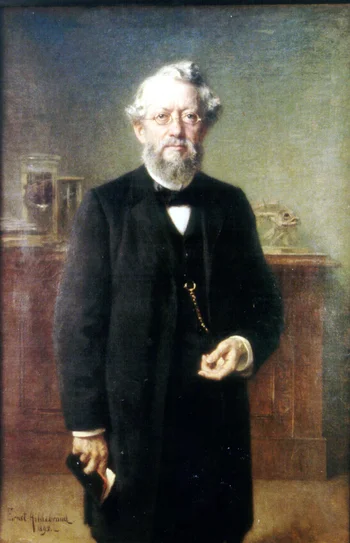
Henry Fuseli
February 7, 1741 — April 16, 1825 — Zurich, Switzerland
Henry Fuseli was a Swiss-born painter, draughtsman, and writer on art who spent the majority of his influential career in Britain. Renowned for his dramatic, often unsettling imagery drawn from literature, mythology, and dreams, he became one of the pioneering figures of Romantic art. His most famous work, The Nightmare, remains one of the most iconic images of the eighteenth century.
Early Life and Education
Henry Fuseli was born Johann Heinrich Füssli on February 7, 1741, in Zurich, Switzerland, the son of a portrait painter and art historian. Rather than pursuing art immediately, he trained in theology and was ordained as a Zwinglian minister in 1761. However, his career as a clergyman was cut short after he and a friend exposed a corrupt local magistrate, forcing him to flee Zurich to avoid the man's powerful allies. He traveled first to Berlin, where he worked as a writer and translator, before settling in London in 1764. There, he worked as a literary agent and translator while immersing himself in England's cultural circles. It was the celebrated portraitist Sir Joshua Reynolds who, upon seeing Fuseli's drawings, urged him to abandon writing and dedicate himself fully to painting. Taking this advice to heart, Fuseli traveled to Italy in 1770, where he spent eight formative years studying the works of Michelangelo and the classical masters, an experience that profoundly shaped his bold, muscular style and his fascination with the sublime and the terrifying in art.
Career and Major Works
After returning to England in 1778 and anglicizing his name to Henry Fuseli, he quickly established himself within London's artistic community. In 1781, he exhibited The Nightmare at the Royal Academy, a haunting depiction of a woman in troubled sleep, tormented by a grotesque incubus, that captured the public imagination and remains his most celebrated painting. Fuseli became a leading contributor to major artistic ventures of the era, including John Boydell's ambitious Shakespeare Gallery, for which he produced several dramatic scenes. He later created his own ambitious project, the Milton Gallery, a series of paintings inspired by the poetry of John Milton, which he exhibited in 1799 and 1800. Fuseli was elected a Royal Academician in 1790, and his standing within British art institutions continued to grow. In 1799, he was appointed Professor of Painting at the Royal Academy, and in 1804 he became its Keeper, a position responsible for overseeing the Academy's schools and collections. Throughout his career, Fuseli cultivated a distinctive visual language marked by theatrical poses, exaggerated musculature, and psychologically charged subject matter, often exploring themes of horror, eroticism, and the supernatural drawn from Shakespeare, Milton, and Norse mythology.
Did You Know?
Fuseli's 1781 masterpiece The Nightmare was so popular that he painted several versions of it, and prints of the image were widely sold and even satirized in political cartoons of the time. The painting is often cited as an early visual exploration of what we now call sleep paralysis, centuries before the phenomenon was scientifically studied.
Legacy and Influence
Fuseli's influence extended well beyond his own canvases. As a teacher and critic, he mentored a generation of British artists and became a close friend and admirer of the visionary poet-artist William Blake, whose own imaginative style bore traces of Fuseli's dramatic sensibility. Fuseli also wrote extensively on art theory, translating Johann Winckelmann's writings and delivering influential lectures at the Royal Academy that shaped contemporary understanding of aesthetics and the sublime. He continued working and teaching until late in life, remaining a vital presence in London's art world for over four decades. Henry Fuseli died on April 16, 1825, at Putney Hill in London, at the home of the Countess of Guilford, and was buried in St Paul's Cathedral. Today, he is regarded as a crucial precursor to Romanticism and a significant influence on later movements exploring dreams, the unconscious, and the macabre, including Symbolism and Surrealism. The Nightmare in particular has endured as a touchstone image, referenced repeatedly in popular culture, film, and psychology for its haunting depiction of sleep paralysis and nocturnal terror.