Humphry Davy
December 17, 1778 — May 29, 1829 — Penzance, England
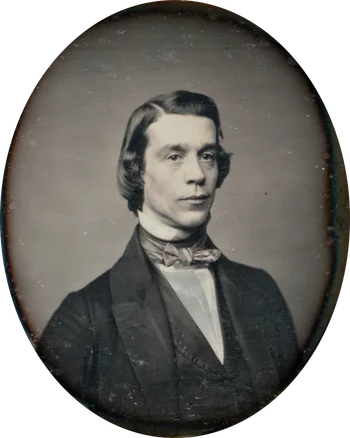
Sir Humphry Davy was a British chemist and inventor whose pioneering use of electricity to isolate chemical elements laid the foundations of electrochemistry. Best known for inventing the Davy lamp, a safety lamp that saved countless miners' lives, he also discovered nitrous oxide's anaesthetic properties and served as President of the Royal Society.
Early Life and Education
Humphry Davy was born in 1778 in Penzance, Cornwall, England, the eldest son of a woodcarver. His father died when Davy was a teenager, leaving the family in financial difficulty, and young Humphry was apprenticed to a local surgeon-apothecary to help support his mother and siblings. Largely self-taught in science, he devoured books on chemistry, philosophy, and languages, showing an early talent for both experimentation and poetry that would remain lifelong interests. His curiosity and ambition soon outgrew Penzance, and in 1798 he secured a position at the Pneumatic Institution in Bristol, an establishment dedicated to investigating the medical uses of gases. There, working under Thomas Beddoes, Davy began the experimental work that would launch his scientific career, most notably his studies of nitrous oxide. This early period established both his reputation as a brilliant experimentalist and his flair for public demonstration, qualities that would define his later career at the Royal Institution in London, where he was appointed lecturer in 1801.
Scientific Achievements
At the Royal Institution, Davy became one of the era's most celebrated scientific lecturers, drawing large public audiences with dramatic chemical demonstrations. Using the newly invented voltaic pile, he pioneered the field of electrochemistry, employing electrolysis to isolate potassium and sodium in 1807, followed by calcium, strontium, barium, magnesium, and boron in 1808. He also established the elemental nature of chlorine and iodine, overturning prevailing chemical theories, and his 1806 Bakerian Lecture, 'On Some Chemical Agencies of Electricity,' was praised by fellow chemist Jöns Jacob Berzelius as among the finest works ever written on chemical theory. In 1799, his experiments with nitrous oxide led him to discover its intoxicating, laughter-inducing effects, earning it the nickname 'laughing gas'; he also foresaw its potential as a surgical anaesthetic decades before the idea took hold in medicine. In 1815, responding to a series of deadly mining explosions, Davy invented the Davy lamp, a safety lamp enclosed in wire gauze that prevented flammable gases from igniting, transforming safety conditions for coal miners across Britain.
Did You Know?
Davy's public lectures on nitrous oxide became fashionable social events, with guests including poets Samuel Taylor Coleridge and Robert Southey inhaling the gas for its euphoric, laughter-inducing effects—decades before doctors adopted it as a surgical anaesthetic.
Later Life and Legacy
Davy's scientific eminence brought him numerous honors: he was knighted in 1812, made a baronet in 1818, and served as President of the Royal Society from 1820 to 1827. He was also a founding member and Fellow of the Geological Society of London, a member of the Royal Irish Academy, the Royal Geological Society of Cornwall, and the American Philosophical Society. Among his notable contributions to science was mentoring Michael Faraday, whom he hired as a laboratory assistant in 1813 and who would go on to become one of history's greatest scientists. Davy's health declined in his later years, worsened by exposure to toxic chemicals and gases during decades of experimentation. He spent his final years traveling in Europe seeking improved health, and died in Geneva, Switzerland, on May 29, 1829, at the age of fifty. His legacy endures through the elements he discovered, the field of electrochemistry he helped found, and the countless miners' lives saved by his safety lamp—a testament to a career that seamlessly blended rigorous science with public engagement and humanitarian invention.