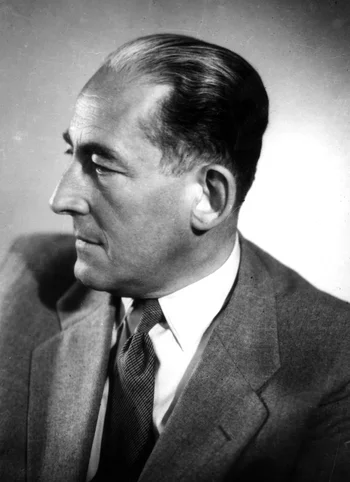
Leonard Baskin
August 15, 1922 — June 3, 2000 — New Brunswick, New Jersey, United States
Leonard Baskin was an American sculptor, draughtsman, and graphic artist whose bold, often haunting depictions of the human figure made him one of the twentieth century's most distinctive artists. As founder of the Gehenna Press, he also became a towering figure in fine printmaking, collaborating with major poets to create some of the era's most beautiful illustrated books. His work, ranging from intimate woodcuts to monumental bronzes, is defined by a preoccupation with mortality, vulnerability, and the fragility of the flesh.
Early Life and Training
Leonard Baskin was born on August 15, 1922, in New Brunswick, New Jersey, the son of a rabbi. Raised in a household steeped in Jewish learning and moral seriousness, he developed an early interest in art and enrolled at New York University before studying sculpture privately and at Yale School of Fine Arts. His formal education was interrupted by service in the United States Navy during World War II. In 1942, while still a young man, Baskin founded the Gehenna Press, initially a modest operation but one that would grow into one of the most respected fine art presses in the world. Even in his youth, Baskin gravitated toward themes of death, suffering, and the human body's imperfections, subjects that would define his mature artistic vision. His early training combined rigorous classical technique with a restless, almost defiant sensibility that resisted the prevailing trends of abstract expressionism dominating American art at the time.
Career and Major Works
Baskin built his reputation as a figurative artist at a moment when abstraction ruled the American art world, carving out a singular niche with sculptures and prints that were unapologetically representational, often grotesque, and emotionally raw. He worked across wood, limestone, and bronze, as well as producing large-scale woodblock prints that combined naturalistic anatomy with fantastical, sometimes disturbing imagery—bloated figures, decaying forms, and hybrid human-animal creatures. Through the Gehenna Press, he published exquisite limited-edition books pairing his stark black-and-white prints with the words of poets including Sylvia Plath, Ted Hughes, Anthony Hecht, and James Baldwin, elevating the press to international acclaim. From 1953 to 1974, Baskin taught printmaking and sculpture at Smith College in Massachusetts, mentoring generations of young artists. His most publicly celebrated achievement came late in his career: The Funeral Cortege, a monumental bronze sculpture created for the Franklin Delano Roosevelt Memorial in Washington, D.C., which cemented his reputation as, in the words of the New York Times, a 'Sculptor of Stark Memorials.'
Did You Know?
Leonard Baskin founded the Gehenna Press in 1942 at just 20 years old, and it went on to collaborate with literary giants like Sylvia Plath and Ted Hughes, becoming one of the most celebrated fine art presses in the world. His bronze sculpture The Funeral Cortege stands today as part of the Franklin Delano Roosevelt Memorial in Washington, D.C.
Later Life and Legacy
In his later decades, Baskin continued producing sculpture, prints, and books, maintaining the Gehenna Press until his death and never abandoning his commitment to the human figure as the central subject of art. He lived for many years in Northampton, Massachusetts, near Smith College, and later spent time in the English countryside, continuing his prolific output well into his seventies. Baskin died on June 3, 2000, in Northampton, Massachusetts, at the age of 77. His legacy endures through his public commissions, his vast body of prints and sculptures held in major museum collections, and the enduring influence of the Gehenna Press on the art of fine bookmaking. Baskin's unwavering dedication to figuration, mortality, and the beauty found in imperfection set him apart from his contemporaries and secured his place as one of the defining American artists of the postwar era.