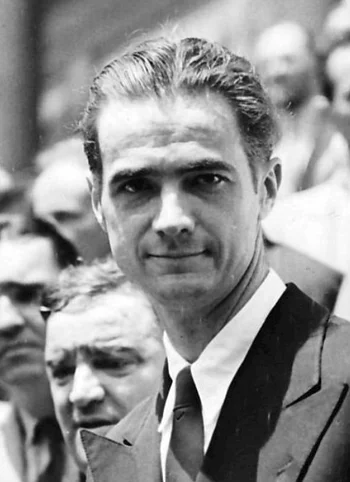
Ernst Krenkel
December 24, 1903 — December 8, 1971 — Bila Tserkva, Russian Empire
Ernst Teodorovich Krenkel was a Soviet Arctic explorer, radio operator, and doctor of geographical sciences whose pioneering work connected the frozen wilderness of the polar regions to the rest of the world. He is best remembered as one of the four scientists of the legendary North Pole-1 drifting ice station, an achievement that earned him the title Hero of the Soviet Union in 1938. Beyond his exploits on the ice, Krenkel became one of the most celebrated amateur radio operators of his era, known internationally by his callsign RAEM.
Early Life and Introduction to Radio
Ernst Krenkel was born in 1903 in the Russian Empire and came of age during the turbulent years surrounding the Russian Revolution and the country's rapid technological transformation. As a young man, he became captivated by the emerging field of radio communication, teaching himself the technical skills of wireless operation at a time when the medium was still in its infancy across the vast Soviet territory. He obtained his first amateur radio license and callsign, EU2EQ, and quickly distinguished himself among the small community of Soviet radio enthusiasts. His technical aptitude and enthusiasm for long-distance communication drew the attention of Soviet scientific and exploratory institutions, which were eager to harness radio technology for mapping and monitoring the country's remote northern territories. This combination of skill and timing set Krenkel on a path toward the Arctic, where reliable communication was both a scientific necessity and a matter of survival for expedition members isolated for months at a time in some of the most hostile environments on Earth.
Arctic Expeditions and the North Pole-1 Mission
Krenkel's career became defined by his participation in a series of ambitious Soviet polar expeditions during the 1930s. He served as radio operator on Arctic missions, including a stint at a remote polar station and later aboard the ill-fated Cheliuskin steamship, whose crew was famously rescued after their vessel was crushed by ice in 1934. His communications work proved essential in coordinating that dramatic rescue, cementing his reputation as one of the Soviet Union's most capable and courageous radio specialists. The pinnacle of his career came in 1937, when he joined Ivan Papanin, Pyotr Shirshov, and Yevgeny Fyodorov on the North Pole-1 expedition, the first team to establish a scientific research station on drifting Arctic ice near the North Pole itself. For nine months, the four men lived on an ice floe that carried them more than 2,000 kilometers across the Arctic Ocean, gathering invaluable scientific data while Krenkel maintained constant radio contact with the outside world, sending updates that captivated the Soviet public. For this feat, he was awarded the title Hero of the Soviet Union in 1938 and later earned a doctorate in geographical sciences.
Did You Know?
Ernst Krenkel's amateur radio callsign, RAEM, became so famous among radio enthusiasts worldwide that after his death, the callsign was retired and used only for special commemorative operations in his honor, a rare tribute in the amateur radio community.
Later Career and Legacy
Following the triumph of North Pole-1, Krenkel transitioned into leadership roles within the Soviet Arctic and hydrometeorological administration, applying his firsthand polar experience to guide broader scientific and logistical efforts across the northern territories. He held prominent positions overseeing radio communications and meteorological services vital to Soviet Arctic development, and he remained an influential voice in both exploration and journalism, writing and speaking about his experiences to inspire future generations of explorers and radio operators. Internationally, he was celebrated within the amateur radio community, where his callsign RAEM became legendary among operators worldwide who prized contacting him from the far reaches of the globe. Krenkel died on December 8, 1971, leaving behind a legacy as both a national hero and a pioneer of polar communication. His work demonstrated how radio technology could bridge the isolation of the Arctic, and he remains a celebrated figure in the history of Soviet exploration, remembered for his bravery, technical brilliance, and role in one of the twentieth century's most daring scientific undertakings.