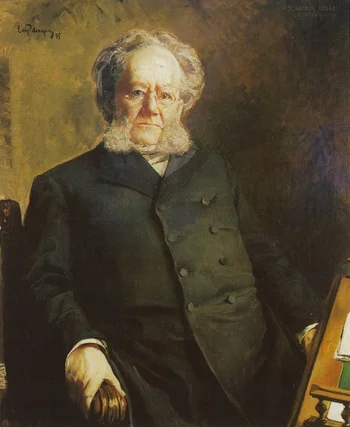
Theodor von Heuglin
March 20, 1824 — November 5, 1876 — Hirschlanden, Kingdom of Württemberg
Martin Theodor von Heuglin was a 19th-century German explorer and ornithologist whose extensive travels through Egypt, Sudan, and Ethiopia produced some of the era's most authoritative studies of African bird life. Trained originally as a mining engineer, he redirected his career toward natural history and became one of Europe's foremost experts on Northeast African fauna. Several species, including Heuglin's Gull and Heuglin's Bustard, still bear his name today.
Early Life and Education
Theodor von Heuglin was born on March 20, 1824, in Hirschlanden, a village in the Kingdom of Württemberg in what is now Germany. He initially pursued studies in mining engineering, training at the Polytechnic School in Stuttgart and later at Tübingen, where he developed technical skills that would later prove useful in surveying remote and difficult terrain. During his studies, however, Heuglin's attention gradually shifted toward the natural sciences, particularly botany and zoology. His growing fascination with wildlife and unexplored regions eventually eclipsed his engineering ambitions. In the late 1840s and early 1850s, he began traveling to Egypt and the surrounding regions, drawn by the opportunity to study flora and fauna largely unknown to European science. These early expeditions set the course for the rest of his life, as he abandoned a conventional engineering career in favor of fieldwork across Northeast Africa. His combination of scientific training and adventurous spirit made him well suited to the rigors of exploration in largely uncharted and often hazardous territory, laying the groundwork for the extensive scientific contributions that would define his career.
Exploration and Ornithological Work
Heuglin spent much of his career traveling through Egypt, Sudan, Ethiopia (then known as Abyssinia), and the Red Sea coastlands, meticulously documenting the region's birds and other wildlife. In 1857, he was appointed Austrian vice-consul in Khartoum, a post that gave him a base from which to launch further expeditions into the Nile basin and surrounding highlands. In 1861, he led an expedition into the Sudanese interior in search of the missing German explorer Eduard Vogel, venturing deep into regions rarely visited by Europeans. Beyond Africa, Heuglin also journeyed to the Arctic, joining an 1870 expedition to Svalbard (Spitsbergen). His scientific output was prolific: he authored major works including "Reise nach Abessinien, den Gala-Ländern, Ost-Sudan und Chartum" (1868) and the monumental "Ornithologie Nordost-Afrikas" (1869–1875), a comprehensive survey that catalogued and described the birdlife of the region in unprecedented detail. These publications established him as a leading authority on African ornithology, synthesizing years of firsthand observation into resources that shaped the field for decades.
Did You Know?
Theodor von Heuglin trained as a mining engineer before ever picking up a pair of binoculars for birdwatching. His eventual expertise in African ornithology was so respected that at least four bird species, including Heuglin's Gull and Heuglin's Robin, were named in his honor.
Legacy and Recognition
Heuglin's contributions to ornithology and African exploration earned him lasting recognition within the scientific community. Numerous species discovered or described during his travels were named in his honor, including Heuglin's Gull (Larus heuglini), Heuglin's Bustard (Neotis heuglinii), Heuglin's Robin, and Heuglin's Masked Weaver, ensuring his name remains attached to the natural history of the regions he studied. His detailed field observations and taxonomic work provided a foundation for later generations of ornithologists studying African bird species, and his written accounts of Northeast Africa offered valuable geographic and ethnographic insights alongside their zoological content. Heuglin died on November 5, 1876, in Stetten, near Kirchheim unter Teck in Württemberg. Though less widely known today than some of his contemporaries in exploration, his meticulous scientific records and specimen collections continued to inform ornithological research long after his death, cementing his place as one of the 19th century's most dedicated and productive naturalist-explorers of the African continent.