Anne Marie Louise d'Orléans
May 29, 1627 — Paris, France
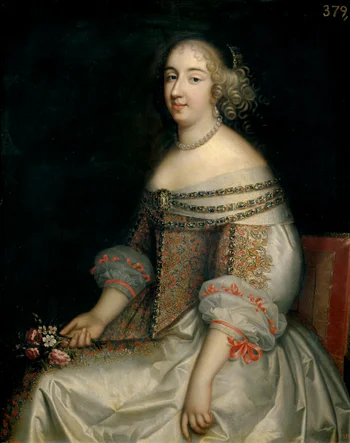
Anne Marie Louise d'Orléans, Duchess of Montpensier, was a French princess known as La Grande Mademoiselle — "The Great Miss" — a title reflecting both her rank as the highest-born unmarried woman in Europe and her forceful personality. The daughter of Gaston, Duke of Orléans (brother of King Louis XIII), she was for decades the wealthiest woman in Europe and an active political figure who played a notable role in the Fronde, the rebellion against Cardinal Mazarin's regency government. She was also a memoirist whose accounts of court life and political events provide an invaluable firsthand record of seventeenth-century France.
The Fronde and Political Rebellion
Born on May 29, 1627, at the Louvre in Paris, Anne Marie Louise was born to enormous wealth and privilege but also to a life of uncertain political standing — her father was perpetually in conflict with the crown, and the question of whom she might marry occupied the courts of Europe for decades without resolution. During the Fronde (1648–53), the series of civil wars against Cardinal Mazarin's regency government, she actively supported the rebellious princes against the young Louis XIV and his mother, Anne of Austria. Her most dramatic action came in 1652 when she ordered the cannon of the Bastille to be fired on royal troops to cover the retreat of the rebel Prince de Condé's forces into Paris — an act that made her famous for boldness but permanently damaged her relationship with the king.
Exile, Romance, and Memoirs
For her role in the Fronde, she was exiled from court for several years. When she returned to Versailles, she remained one of the most prominent figures in French aristocratic society despite her political misadventures. In her late forties she fell deeply in love with the Count of Lauzun, a dashing officer twenty years her junior, and secretly married him — a match that scandalized the court and led to Lauzun's imprisonment in the Bastille for several years. Louis XIV eventually released him partly in exchange for her ceding lands to the king's illegitimate children. The marriage ultimately failed and they separated. Throughout her life she wrote extensively: her Mémoires are an important source for the history of the Fronde and the court of Louis XIV.
Did You Know?
La Grande Mademoiselle ordered the cannon of the Bastille fired during the Fronde — reportedly causing Cardinal Mazarin to quip that this cannon had killed her husband, meaning she had permanently destroyed her chances of a royal marriage through the act.
Legacy
Anne Marie Louise d'Orléans died on April 5, 1693. She never achieved the royal marriage that her birth and fortune seemed to promise — the political obstacles and her own strong will conspired against it. But she left behind a personality and a written record of remarkable vividness. Her Mémoires offer an intimate portrait of an extraordinary era, and her willingness to act boldly — whether firing cannon during a civil war or pursuing an unsuitable love — made her one of the most memorable figures in the rich history of the French court.