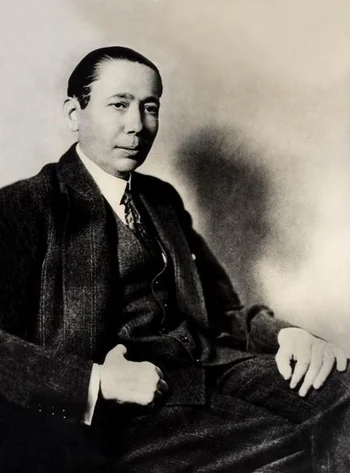
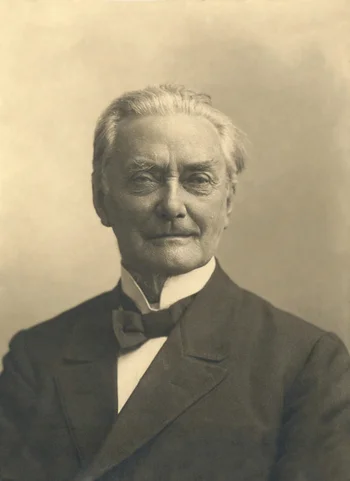
Robert Emden
March 4, 1862 — October 8, 1940 — St. Gallen, Switzerland
Robert Emden was a Swiss astrophysicist and meteorologist whose pioneering work on the physics of stars helped establish the mathematical foundations of stellar structure theory. He is best remembered for the Lane–Emden equation, a cornerstone of astrophysical modeling that describes how self-gravitating gas spheres behave. His 1907 book Gaskugeln remains a landmark text in the history of astrophysics.
Early Life and Education
Jacob Robert Emden was born on March 4, 1862, into a Swiss family with strong intellectual and commercial ties across Europe. He grew up during a period of rapid scientific advancement, when physics and mathematics were increasingly being applied to natural phenomena beyond the laboratory. Emden pursued higher education in physics, developing a deep interest in thermodynamics and the mechanical theory of heat, disciplines that were then transforming scientists' understanding of energy, gases, and physical systems. His studies eventually led him toward the emerging field of astrophysics, where the tools of theoretical physics could be applied to understand the composition and behavior of celestial bodies. Emden's academic training grounded him firmly in the mathematical rigor that would later define his most important contributions. While much of his early career remains less documented than his later achievements, it is clear that his combined interests in meteorology and physics uniquely positioned him to bridge terrestrial and cosmic applications of thermodynamic theory. This interdisciplinary foundation set the stage for the ambitious project that would occupy much of his professional life: applying the mechanical theory of heat to both meteorological and cosmological problems, an effort that culminated in his most famous published work.
Career and the Lane–Emden Equation
Emden's crowning achievement came in 1907 with the publication of Gaskugeln: Anwendungen der mechanischen Wärmetheorie auf kosmologische und meteorologische Probleme ("Gas Spheres: Applications of the Mechanical Theory of Heat to Cosmological and Meteorological Problems"). In this seminal work, Emden developed a mathematical model describing polytropic gaseous stellar objects — spheres of gas held together and shaped by their own gravitational force while following a specific pressure-density relationship. The resulting differential equation, now known as the Lane–Emden equation, built upon earlier work by American astronomer Jonathan Homer Lane and provided a rigorous framework for understanding the internal structure of stars. The equation allowed astrophysicists to model how pressure, density, and temperature vary within a star from its core to its surface under conditions of hydrostatic equilibrium. Emden's formulation became indispensable for calculating stellar models and remains a fundamental tool in astrophysics to this day, applied in the study of stellar interiors, white dwarfs, and other astronomical objects. Beyond stellar physics, Emden also applied thermodynamic principles to meteorological problems, reflecting his broader interest in using the mechanical theory of heat to explain natural phenomena in both the atmosphere and the cosmos, unifying seemingly disparate fields under a common mathematical language.
Did You Know?
The Lane–Emden equation that bears Robert Emden's name was actually built upon earlier foundational work by American astronomer Jonathan Homer Lane, yet it was Emden's rigorous 1907 formulation in Gaskugeln that made the equation a standard tool for modeling stellar interiors — a testament to how his mathematical treatment transformed a preliminary idea into an enduring cornerstone of astrophysics.
Legacy and Lasting Influence
Robert Emden died in 1940, leaving behind a body of work that profoundly shaped twentieth-century astrophysics. The Lane–Emden equation continues to be taught in astrophysics courses worldwide and remains central to the study of stellar structure, forming a critical link between classical thermodynamics and modern astrophysical modeling. Later astronomers and physicists, including Arthur Eddington and Subrahmanyan Chandrasekhar, built upon the polytropic models Emden helped formalize, extending them to explain phenomena such as the internal structure of white dwarf stars. Emden's interdisciplinary approach — bridging meteorology and astrophysics through shared thermodynamic principles — exemplified the growing trend in early twentieth-century science toward applying rigorous mathematical physics to diverse natural systems. Though not as widely known to the general public as some of his contemporaries, Emden's contributions remain foundational within the technical literature of astrophysics. His name endures wherever scientists model the equilibrium structure of stars, and his 1907 treatise is still referenced as a classic text illustrating how careful application of physical theory can unlock understanding of the universe's most fundamental objects, securing his place in the history of modern astronomical science.