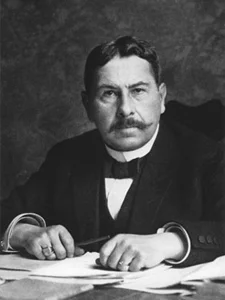
John Ambrose Fleming
November 29, 1849 — April 18, 1945 — Lancaster, England
Sir John Ambrose Fleming was a British electrical engineer and physicist whose 1904 invention of the thermionic valve, or vacuum tube diode, launched the age of modern electronics. A pioneer of wireless telegraphy, he also devised the right-hand and left-hand rules still taught in physics classrooms today. His work bridged the gap between theoretical science and the practical technologies that defined the twentieth century.
Early Life and Education
John Ambrose Fleming was born on November 29, 1849, in Lancaster, England, the eldest of seven children of a Congregationalist minister. From a young age he displayed a talent for building mechanical models and conducting experiments, foreshadowing his later career. He studied at University College London, where he earned a Bachelor of Science degree, before continuing his education at St John's College, Cambridge, under the physicist James Clerk Maxwell. At Cambridge he immersed himself in the study of electromagnetism, a field then still in its infancy. After completing his studies, Fleming taught briefly before returning to research and consultancy work in electrical engineering. His early career included work as a scientific advisor to the Edison Electric Light Company, where he gained firsthand experience with the practical challenges of incandescent lighting and electrical current. This blend of rigorous academic training and hands-on industrial experience shaped his approach to invention throughout his life, giving him both the theoretical grounding and the engineering pragmatism needed for the breakthroughs to come.
Career and Major Achievements
In 1885, Fleming became the first professor of electrical engineering at University College London, a post he held for decades while consulting for major companies including the Marconi Wireless Telegraph Company. He played a critical technical role in Guglielmo Marconi's transmission of the first transatlantic radio signal in 1901, designing the powerful transmitting equipment used at Poldhu, Cornwall. Building on his knowledge of the Edison effect, Fleming invented the thermionic valve, or vacuum tube diode, in 1904. This device could detect and rectify radio signals, and it became the foundational component of early radio receivers, amplifiers, and eventually computers, earning Fleming recognition as a father of modern electronics. He also formulated Fleming's right-hand rule for generators and left-hand rule for electric motors, elegant mnemonic devices that remain standard tools for physics students worldwide for determining the direction of induced current and force. Fleming published extensively, authored influential textbooks on electrical engineering, and held numerous patents. His combination of theoretical insight and practical invention made him one of the most respected engineers of his era, and his work laid essential groundwork for the electronic and communications industries that followed.
Did You Know?
Fleming's 1904 vacuum tube diode, often called the 'Fleming valve,' was inspired by an odd phenomenon he had observed years earlier while working with Thomas Edison's light bulbs—current mysteriously flowing in only one direction inside a vacuum. He turned this curious 'Edison effect' into the invention that essentially launched the electronics industry.
Later Life and Legacy
Fleming remained active in scientific and public life well into old age. He was knighted in 1929 in recognition of his contributions to electrical engineering, and he received numerous honors from scientific societies throughout Britain and abroad. In his later years, Fleming also became known for his strong religious convictions, opposing Darwinian evolution and helping found the Evolution Protest Movement, reflecting his belief that science and Christian faith could coexist. He continued writing and lecturing on both technical and religious subjects until shortly before his death. Fleming died on April 18, 1945, in Sidmouth, England, at the age of 95, having lived through the transition from gaslight to the electronic age he helped create. His invention of the vacuum tube diode is widely regarded as the birth of modern electronics, enabling the development of radio, television, radar, and early computing devices. Fleming's rules remain a staple of physics education, and his name is honored through awards, university buildings, and the IEEE, which continues to recognize his foundational contributions to electrical engineering.