Tatyana Afanasyeva-Ehrenfest
November 29, 1876 — April 14, 1964 — Kiev, Russian Empire
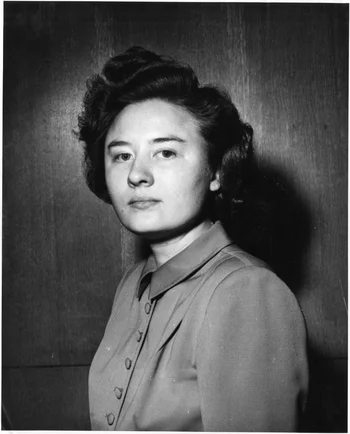
Tatyana Alexeyevna Afanasyeva-Ehrenfest was a Russian-Dutch mathematician and physicist best remembered for her collaboration with her husband, Paul Ehrenfest, on the theoretical foundations of statistical mechanics. Working largely outside the formal academic system that excluded women of her generation, she nonetheless helped produce one of the most influential review articles in the history of statistical physics. Later in life she turned her attention to mathematics education, leaving a lasting mark on how geometry was taught in Dutch schools.
Early Life and Education
Tatyana Afanasyeva was born on November 29, 1876, in Kiev, then part of the Russian Empire, into a family that valued education. She pursued advanced studies in mathematics at a time when Russian universities offered women only limited access to higher education, attending courses connected to St. Petersburg's academic circles and encountering the work of prominent mathematicians such as Alexander Lyapunov. Seeking further training, she traveled to Göttingen, Germany, then one of the world's foremost centers for mathematics and physics under the influence of Felix Klein and David Hilbert. It was there that she met the young Austrian physicist Paul Ehrenfest, who shared her passion for the foundations of theoretical physics. The two formed both an intellectual partnership and a personal one, marrying in 1904. Their union was notable for its intellectual equality; Tatyana was recognized by colleagues as a rigorous and original thinker in her own right, not merely an assistant to her husband. This early period in Göttingen shaped the questions about probability, mechanics, and the nature of physical law that would occupy much of her later career.
Statistical Mechanics and the Ehrenfest Collaboration
After their marriage, Tatyana and Paul Ehrenfest lived in Vienna and then St. Petersburg before settling in Leiden, the Netherlands, in 1912, when Paul succeeded Hendrik Lorentz as professor of theoretical physics. Their most enduring joint achievement was the 1911 article 'The Conceptual Foundations of the Statistical Approach in Mechanics,' written for the German Encyklopädie der mathematischen Wissenschaften. In this dense and meticulous survey, the couple clarified the logical foundations of statistical mechanics, scrutinizing concepts such as the ergodic hypothesis and Ludwig Boltzmann's H-theorem. As part of this work, they devised the now-famous Ehrenfest urn model, a simple probabilistic scheme that illustrated how irreversibility and the approach to equilibrium could emerge from underlying reversible, deterministic dynamics. The paper became a standard reference for physicists grappling with the relationship between microscopic mechanics and macroscopic thermodynamic behavior, and it remains cited by historians and philosophers of physics today. Tatyana's contributions to this work reflected her strong grounding in probability theory and her insistence on conceptual clarity, complementing Paul's broader physical intuition.
Did You Know?
The Ehrenfest urn model, which Tatyana co-developed with her husband Paul, is still taught in probability and statistical mechanics courses today as a simple, elegant illustration of how irreversible, thermodynamic-like behavior can arise from purely reversible random processes.
Later Life and Legacy
The Ehrenfests' life in Leiden was marked by both scientific achievement and personal hardship, including the challenges of raising a son with Down syndrome and Paul's struggles with depression, which ended in his suicide in 1933. Tatyana remained in Leiden after his death and redirected much of her energy toward mathematics education, becoming an influential voice in reforming how geometry was taught in Dutch schools. She argued for teaching methods grounded in visual and intuitive understanding rather than rote memorization, ideas that influenced Dutch pedagogy for decades afterward. She continued this educational work alongside her earlier scientific interests until her death in Leiden on April 14, 1964. Today, Tatyana Afanasyeva-Ehrenfest is remembered both as a co-creator of foundational tools in statistical mechanics—the Ehrenfest urn model still appears in probability courses worldwide—and as an early advocate for accessible, intuitive mathematics teaching, a dual legacy that reflects the breadth of her intellectual contributions across physics, mathematics, and education.