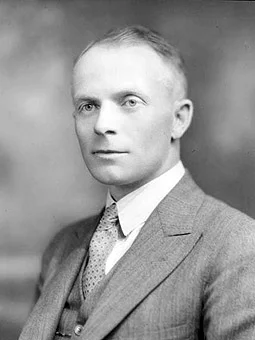
Michael J. S. Dewar
September 24, 1918 — October 10, 1997 — Ahmednagar, India
Michael James Steuart Dewar was a British-born American theoretical chemist celebrated for transforming organic chemistry into a quantitative, predictive science. He developed widely used semi-empirical molecular orbital methods, including MINDO, MNDO, and AM1, that allowed chemists to calculate molecular structures and reactivity on computers decades before modern computational power became commonplace. His work bridged the gap between classical organic chemistry intuition and rigorous quantum mechanical theory.
Early Life and Education
Michael Dewar was born on September 24, 1918, in Ahmednagar, India, then part of British India, to British parents. He was educated in England, attending Winchester College before going up to Balliol College, Oxford, where he studied chemistry. At Oxford he came under the influence of Robert Robinson, one of the era's leading organic chemists, and developed an early fascination with the relationship between molecular structure and chemical reactivity. Dewar completed his doctorate at Oxford, where his interest in applying physical and theoretical principles to organic chemistry began to take shape. This period established the intellectual foundation for what would become his life's work: using mathematical and quantum mechanical tools to explain and predict the behavior of organic molecules, a pursuit that set him apart from many of his contemporaries who relied primarily on empirical observation and synthetic experience.
Career and Major Contributions
Dewar's career spanned academic posts in Britain and the United States, including positions at Queen Mary College, University of London, before he moved permanently to the United States, eventually settling at the University of Texas at Austin, where he spent much of his most productive research career. He became a naturalized American citizen and was widely regarded as one of the founders of modern computational organic chemistry. Dewar is best known for developing a series of semi-empirical quantum mechanical methods—MINDO, MNDO, AM1, and later PM3—that made it computationally feasible to model the electronic structure of organic molecules. He also proposed the Dewar-Zimmerman treatment of pericyclic reactions, an alternative framework to the Woodward-Hoffmann rules for predicting reaction outcomes based on orbital symmetry. Additionally, the unstable bicyclic isomer of benzene known as 'Dewar benzene' bears his name, reflecting his early theoretical predictions about strained ring systems. His prolific output included hundreds of papers and several influential textbooks on molecular orbital theory.
Did You Know?
Dewar's theoretical predictions about a highly strained, unstable isomer of benzene were so significant that the compound was later named 'Dewar benzene' in his honor, even though he never synthesized it himself. It was eventually made by other chemists and confirmed many of his structural insights.
Later Years and Legacy
In his later career, Dewar continued refining his semi-empirical methods at the University of Florida, where he worked until his death. His computational approaches became foundational tools in computational chemistry, enabling researchers worldwide to predict molecular geometries, energies, and reaction pathways with a level of practicality that more rigorous ab initio methods could not yet match given the computing resources of the time. Dewar received numerous honors during his career, including election to the Royal Society and other prestigious scientific bodies, in recognition of his transformative impact on theoretical chemistry. He died on October 10, 1997, in Gainesville, Florida. Today, chemists still use descendants of his semi-empirical methods in drug design, materials science, and academic research, and his conceptual frameworks for understanding organic reactivity remain part of the standard chemistry curriculum, cementing his legacy as one of the twentieth century's most influential theoretical chemists.